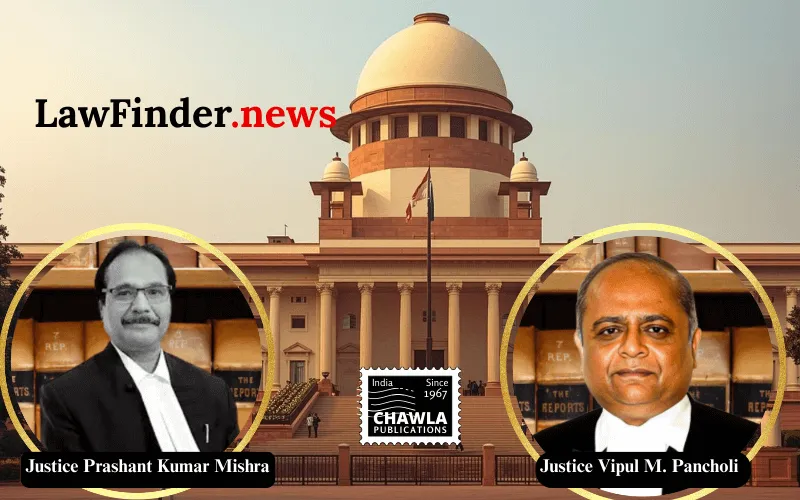
Supreme Court Upholds Statutory Bar on Gratuity Payment Pending Proceedings, The Court dismisses appeal, emphasizing the protective nature of Rule 69(1)(c) of the CCS (Pension) Rules, 1972, and calls for expedited trial in CPMT paper leak case.
In a significant ruling, the Supreme Court of India has dismissed the appeal of Bikram Chand Rana, a retired Senior Assistant of the Himachal Pradesh Road Transport Corporation, upholding the statutory bar on the release of gratuity while departmental and judicial proceedings are pending. The decision was rendered by a bench comprising Justices Prashant Kumar Mishra and Vipul M. Pancholi, reinforcing the interpretation of Rule 69(1)(c) of the Central Civil Services (Pension) Rules, 1972.
The appellant, Bikram Chand Rana, who retired from service on February 28, 2009, challenged the withholding of his gratuity due to the ongoing judicial proceedings in connection with the 2006 Combined Pre-Medical Test (CPMT) paper leak scandal. The Supreme Court supported the findings of the High Court of Himachal Pradesh, which had earlier dismissed Rana's appeal, and clarified that the Rule operates as a statutory embargo rather than an enabling provision.
The Court highlighted that the phrase "departmental or judicial proceedings" in Rule 69(1)(c) indicates that gratuity cannot be paid until the conclusion of either type of proceeding. This interpretation aims to protect the financial interests of the State, ensuring that gratuity is not prematurely disbursed when potential liabilities remain unresolved.
The appellant's argument, which suggested that the conclusion of any one proceeding should suffice for gratuity release, was rejected by the Court. The bench explained that such a reading would undermine the rule's protective purpose and potentially result in financial loss to the government.
Furthermore, the Court emphasized the distinction between departmental and judicial proceedings, noting that while they may arise from the same allegations, they differ in scope and standard of proof. An acquittal in a criminal case does not necessarily preclude liability in a departmental inquiry conducted on the preponderance of probabilities.
The Supreme Court also addressed the appellant's reliance on Rule 9(1) of the 1972 Rules, which concerns the President's right to withhold pension or gratuity. The Court clarified that this rule comes into play only after a conclusive finding of misconduct in proceedings, and cannot be used to justify gratuity payment during pending proceedings.
In conclusion, the Court found no merit in the appeal and dismissed it, while reiterating the High Court's directive to expedite the trial related to FIR No. 140/2006, in which the appellant is implicated.
Bottom Line:
Gratuity cannot be released under Rule 69(1)(c) of the Central Civil Services (Pension) Rules, 1972, until the conclusion of both departmental and judicial proceedings, as the rule operates as a statutory bar and not as an enabling provision.
Statutory provision(s): Central Civil Services (Pension) Rules, 1972 Rule 69(1)(c), Central Civil Services (Pension) Rules, 1972 Rule 9(1), Central Civil Services (Classification, Control and Appeal) Rules, 1965 Rule 14, Central Civil Services (Conduct) Rules, 1964 Rule 3.
Bikram Chand Rana v. Himachal Pradesh Road Transport Corporation, (SC) : Law Finder Doc id # 2879270