Court Finds Circumstantial Evidence Incomplete and DNA Evidence Unreliable; Emphasizes Presumption of Innocence and Proof Beyond Reasonable Doubt
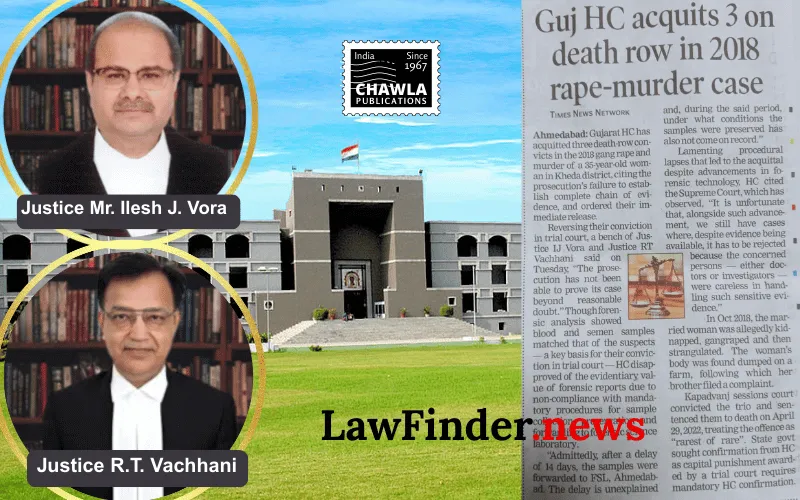
In a significant judgment delivered on January 13, 2026, the Gujarat High Court (Division Bench comprising Justices Ilesh J. Vora and R. T. Vachhani) acquitted three accused-Gopi @ Bhalabhai Girishbhai Devipujak, Jayantibhai Vadi, and Lalabhai Vadi-who were earlier convicted and sentenced to death for the gang rape and murder of a married woman, identified as ‘X’. The trial court had convicted the accused under Sections 302 (murder), 201 (causing disappearance of evidence), 366 (kidnapping), and 376(d) (gang rape) of the Indian Penal Code, 1860, awarding capital punishment to Gopi and life imprisonment to others along with fines.
The High Court, after detailed scrutiny of the evidence on record, set aside the death sentence and acquitted the accused, holding that the prosecution failed to establish a complete and unbroken chain of circumstantial evidence pointing unequivocally to the guilt of the accused. The Court emphasized that suspicion, however strong, cannot substitute proof beyond reasonable doubt.
The case facts revealed that on October 28, 2018, the accused allegedly kidnapped the victim from Village Motijer and took her to a farm in Village Nirmali, where she was gang-raped and strangulated to death. The dead body was found in a naked state in the farm the next day. The prosecution’s case largely rested on circumstantial evidence including the “last seen together” theory, an extrajudicial confession purportedly made by accused Gopi to a witness, medical history recorded by the examining doctor, and DNA profiling reports.
However, the High Court found material gaps and contradictions in the prosecution’s case:
1. Last Seen Theory Weak:
The witnesses who claimed to have last seen the accused with the deceased either did not know the accused personally or their testimonies were inconsistent. For instance, the grocery shop owner (PW-15) identified the accused only after police showed them to him, and admitted inability to recall clearly due to shop rush. The tractor driver (PW-16) gave an account contradicted by the 164 Cr.P.C. statement of another witness, making the timeline and presence of accused at the scene doubtful.
2. Extrajudicial Confession Not Credible:
The alleged confession by accused Gopi before a friend (PW-13) was a vague one-line statement “I have killed my aunt” without details of time, place, or manner of the crime. The Court noted that extrajudicial confessions are inherently weak evidence requiring strong corroboration, which was missing here.
3. Medical History Evidence Inadmissible:
Statements recorded by the doctor during medical examination in the presence of police were held inadmissible under Sections 25 and 26 of the Indian Evidence Act, as confession made in police custody without Magistrate’s presence cannot be used against accused.
4. DNA Evidence Unreliable Due to Procedural Lapses:
There was an unexplained delay of 14 days in sending the collected DNA samples from the police station to the Forensic Science Laboratory (FSL). The Court emphasized the necessity of maintaining an unbroken chain of custody and proper preservation protocols for DNA evidence as laid down in recent Supreme Court rulings. Due to lack of evidence on how samples were stored and transported, the DNA profiling report’s sanctity was questioned, rendering it untrustworthy for conviction.
5. Discovery Panchnama Not Properly Proven:
The Court observed that the prosecution failed to prove the exact contents of the disclosure statement and place pointing panchnama by the accused, which is essential for relying on discovery evidence under Section 27 of the Evidence Act.
Reiterating the fundamental principle of criminal jurisprudence that an accused is presumed innocent until proven guilty beyond reasonable doubt, the Court held that the prosecution failed to meet the high standard required. The judgment cited various Supreme Court precedents emphasizing that conviction based on circumstantial evidence requires a complete chain with no gaps, and suspicion alone cannot sustain a conviction.
Ultimately, the High Court allowed Criminal Appeal Nos. 1139 and 1813 of 2022, set aside the conviction and death sentence, and ordered immediate release of the accused unless they were required in other cases.
This judgment underscores the judiciary’s commitment to safeguarding the rights of accused by ensuring strict compliance with evidentiary standards, especially in cases relying on circumstantial evidence and scientific reports like DNA profiling.
Bottom Line:
Circumstantial evidence must form a complete chain unerringly pointing towards the guilt of the accused; suspicion, however strong, cannot replace proof beyond reasonable doubt.
Statutory provision(s): Indian Penal Code Sections 302, 201, 366, 376(d); Indian Evidence Act Sections 25, 26, 27; Criminal Procedure Code Section 164