Pareshbhai Taviyad's conviction for murdering his wife during a domestic dispute is affirmed by the Gujarat High Court, dismissing claims of suicide.
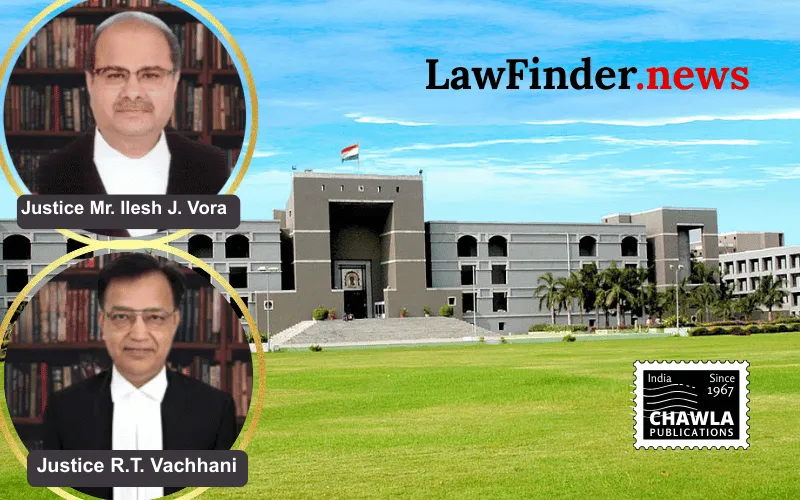
In a significant ruling, the Gujarat High Court has confirmed the life imprisonment of Pareshbhai Shankerbhai Taviyad for the murder of his wife, Rekhaben, during a domestic altercation. The division bench, consisting of Justices Ilesh J. Vora and R.T. Vachhani, upheld the conviction under Section 302 of the Indian Penal Code, dismissing the appellant's defense of suicide.
The court meticulously reviewed the evidence presented, including medical, forensic, and witness testimonies, to conclude that the death was a result of homicidal strangulation rather than suicide. The postmortem report revealed critical findings, such as horizontal ligature marks, a fractured thyroid cartilage, and petechial hemorrhages, which corroborated the prosecution's case of intentional strangulation using a cotton rope during a domestic quarrel.
The defense's argument of suicide was rejected as inconsistent with the forensic and circumstantial evidence. The court noted the absence of signs typical of hanging, such as salivary dribbling and an oblique ligature mark, further affirming the prosecution's narrative of staged suicide. The expert medical opinion, while advisory, was supported by independent evidence, establishing the homicidal nature of the death beyond reasonable doubt.
Additionally, the court addressed the application of Section 106 of the Evidence Act, which shifts the burden of proof to the accused to explain circumstances within his exclusive knowledge. The appellant's inability to provide a plausible explanation strengthened the prosecution's case.
The court also dismissed the appellant's claims of an impulsive act during a sudden quarrel, emphasizing the deliberate nature of the act. The evidence of prior domestic disputes and the accused's conduct post-incident, including the lodging of a false report, further cemented the conviction.
The judgment serves as a stern reminder of the legal repercussions of domestic violence and the judiciary's commitment to delivering justice. The High Court's decision upholds the principles of law and reinforces the importance of thorough judicial scrutiny in cases involving domestic violence and homicide.
Bottom Line:
Conviction under Section 302 IPC upheld for homicidal strangulation of wife during a domestic quarrel. Prosecution proved beyond reasonable doubt the chain of circumstances, corroborated by medical and forensic evidence. Defence of suicide rejected as inconsistent with evidence.
Statutory provision(s): Section 302 IPC, Section 182 IPC, Section 106 of the Indian Evidence Act, Section 45 of the Indian Evidence Act, Section 313 of the Code of Criminal Procedure
Pareshbhai Shankerbhai Taviyad v. State of Gujarat, (Gujarat)(DB) : Law Finder Doc id # 2873300