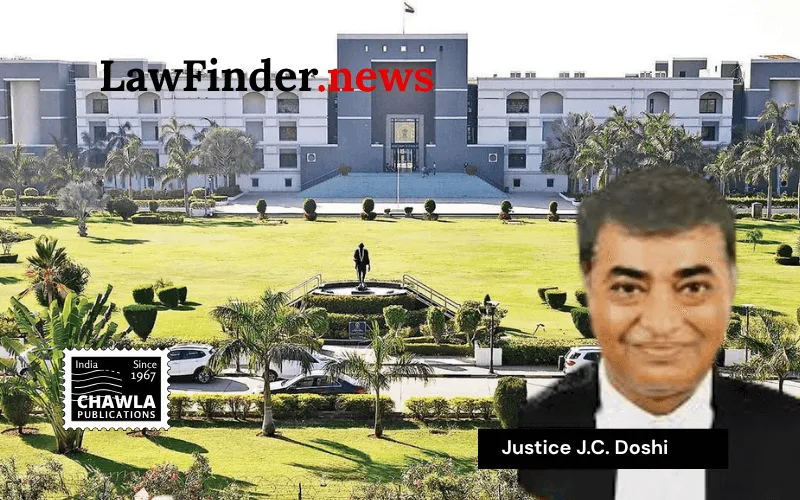
Court Confirms Testamentary Rights Over Self-Acquired Property; Dismisses Second Appeal on Substantial Questions of Law
In a significant judgment, the Gujarat High Court has dismissed a second appeal filed by Mahesh Natubhai Gamit and others, challenging the validity of a Will executed by the deceased Reshiabhai. The court upheld the previous decision of the Principal District Judge, Navsari, which found the Will to be genuine and the properties in question to be self-acquired, rather than ancestral.
Presiding over the case, Justice J. C. Doshi reaffirmed the principles governing the determination of substantial questions of law under Section 100 of the Civil Procedure Code. The court emphasized that its jurisdiction in a second appeal is confined to substantial questions of law, which were not demonstrated in this case.
The dispute centered on a Will dated April 15, 1986, allegedly executed by Reshiabhai, the grandfather of appellant Nos. 1 to 4. The appellants claimed that the properties bequeathed were ancestral and that the Will was procured through fraud and undue influence. However, the High Court found that the properties were self-acquired by Reshiabhai, dismissing the appellants' claims of ancestral rights.
The court meticulously analyzed revenue entries and antecedent records, concluding that the ancestral character of the suit properties was not established. In its judgment, the court noted that the properties were held by Reshiabhai and Ranchhodbhai as co-owners, and a family arrangement had been effected, thereby negating the claim of coparcenary property.
Furthermore, the court upheld the testamentary disposition of self-acquired property under Section 30 of the Hindu Succession Act, 1956, affirming that there was no restriction on testamentary competence over such property. The execution of the Will was found to be in accordance with legal requirements, supported by substantial evidence, including the testimony of attesting witnesses and the Sub-Registrar's endorsement.
The High Court's decision underscores the importance of distinguishing between ancestral and self-acquired property in testamentary cases and reiterates the legal standards for proving a Will's validity. The judgment serves as a precedent in similar disputes, reinforcing the rights of individuals to dispose of their self-acquired property through testamentary instruments.
Bottom Line:
Second Appeal under Section 100 CPC - Determination of substantial questions of law regarding testamentary disposition and ancestral property.
Statutory provision(s):
Civil Procedure Code, 1908 Section 100, Indian Succession Act, 1925 Section 63, Indian Evidence Act, 1872 Section 68, Hindu Succession Act, 1956 Section 30
Mahesh Natubhai Gamit v. Chhaganbhai Reshiabhai, (Gujarat) : Law Finder Doc id # 2850361