Suppression of Facts and Unlawful Claims Lead to Dismissal; Court Warns Against Future Misconduct
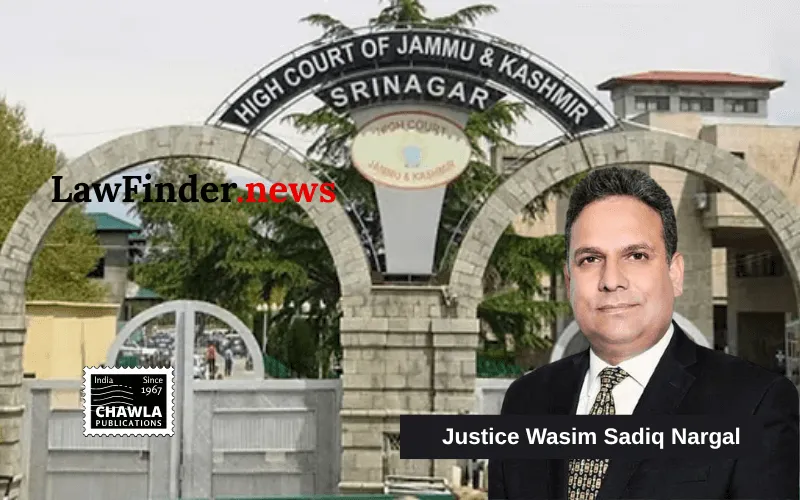
In a significant ruling, the Jammu and Kashmir High Court has dismissed two writ petitions filed by Radha Krishen Koul and others, challenging eviction notices and seeking proprietary rights under a government order. The case, heard by Justice Wasim Sadiq Nargal, revolved around claims of entitlement to proprietary rights based on an unconstitutional statute and alleged discrimination under Article 14 of the Indian Constitution.
The petitioners sought relief under Government Order No. Rev/NDK/248 of 1981, contending that similar leaseholders had been granted proprietary rights. However, the court found that the petitioners were not lessees at the relevant time, as their lease had expired in 1974 and was only renewed in 1982. Consequently, their claims under the 1981 order were deemed untenable.
Further complicating matters, the petitioners had previously obtained ownership rights under the J&K State Lands (Vesting of Ownership Rights) Act, 2001, commonly referred to as the Roshni Act. This Act was declared unconstitutional and void ab initio by a Division Bench of the High Court in 2020. As a result, any rights acquired under it were invalidated, negating the petitioners' claims for proprietary rights based on this statute.
The court also addressed the petitioners' challenge to an eviction notice issued under the Jammu and Kashmir Public Premises (Eviction of Unauthorized Occupants) Act, 1988. Justice Nargal affirmed the legality of the notice, stating that the Estate Officer acted within the statutory framework to evict unauthorized occupants following the expiry of the lease in 2014.
A critical aspect of the judgment was the court's observation regarding the petitioners' conduct. The High Court highlighted the suppression of material facts, including the withdrawal of previous petitions after respondents filed replies. This act of misleading the court constituted an abuse of legal processes and disqualified the petitioners from receiving equitable relief under Article 226.
In its conclusion, the court dismissed both petitions, emphasizing that litigants must approach the judiciary with transparency and honesty. Justice Nargal refrained from imposing costs due to the petitioners' advanced age but issued a stern warning against future misconduct.
The ruling underscores the judiciary's stance against attempts to manipulate legal processes through deceit and reinforces the importance of candid disclosures in writ petitions.
Bottom Line:
Petitioners' claims for proprietary rights under a government order were denied as they were not lessees of the property at the relevant time and had obtained rights under the subsequently invalidated J&K State Lands (Vesting of Ownership Rights) Act, 2001. Suppression of material facts by the petitioners further dis-entitled them to equitable relief.
Statutory provision(s): Article 226 of the Constitution of India, Jammu and Kashmir Public Premises (Eviction of Unauthorized Occupants) Act, 1988, J&K State Lands (Vesting of Ownership Rights) Act, 2001