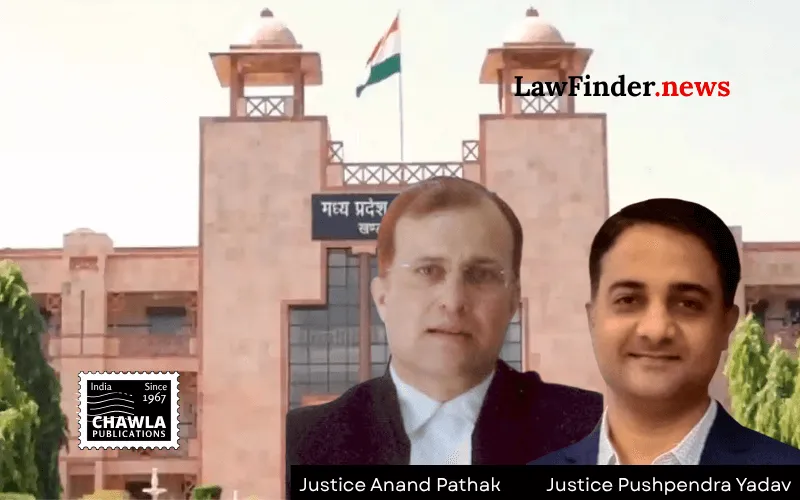
Madhya Pradesh High Court calls for a larger bench review on the role of District Magistrates under the National Security Act, 1980.
In a pivotal development, the Madhya Pradesh High Court has cast a spotlight on the procedural nuances of preventive detention under the National Security Act, 1980. The court, while adjudicating the case of Vikas Tiwari versus the State of Madhya Pradesh, has referred critical questions to a larger bench to ascertain the correct legal position regarding the role of District Magistrates (D.M.) in considering representations against detention orders.
The matter arose when Vikas Tiwari, detained under the National Security Act, challenged the detention order on grounds that the District Magistrate did not explicitly state that a representation could be made to him. This omission, argued Tiwari's counsel, violated procedural safeguards and rendered the detention order void. However, the court observed that, according to the Act, the authority to decide on such representations lies with the State Government, rendering the role of the D.M. secondary post-approval by the State Government.
The court meticulously analyzed the provisions of the National Security Act, particularly Sections 3, 8, and 14, alongside Article 22 of the Indian Constitution, which safeguards procedural rights against preventive detention. It emphasized the procedural obligation that representations should be made to the "appropriate Government," which is the State Government in this context, not the District Magistrate.
The court referenced past judgments, including the Supreme Court's decision in Kamleshkumar Ishwardas Patel v. Union of India, to highlight distinctions between different detention laws and their applicability. The decision underlines that once a detention order is referred to the State Government, the District Magistrate becomes functus officio and cannot entertain representations.
The bench, comprising Justices Anand Pathak and Pushpendra Yadav, has sought clarity on whether non-mentioning the right to represent before the D.M. invalidates the detention process. The court has posed five critical questions for the larger bench, including the authority of the D.M. in considering representations and whether the Full Bench's earlier judgment in Kamal Khare v. State of M.P. aligns with Supreme Court precedents.
As this legal conundrum awaits further scrutiny, the court has advised the petitioner, Vikas Tiwari, to seek interim relief from the larger bench or the appropriate government body as per the Act. The case underscores the complexities involved in balancing national security concerns with constitutional safeguards against arbitrary detention.
Bottom Line:
Preventive detention under the National Security Act, 1980 - District Magistrate (D.M.) not mentioning in the detention order that representation can be made to him - Representation under Section 8 of the Act to be made to the State Government, not the D.M. - Clarification sought on the issue through reference to a Larger Bench.
Statutory provision(s): National Security Act, 1980 Sections 3, 8, 14; Constitution of India Article 22.
Vikas Tiwari v. State of Madhya Pradesh, (Madhya Pradesh)(DB)(Gwalior) : Law Finder Doc id # 2877210