Himachal Pradesh High Court Upholds Trial Court's Decision to Close Evidence Window for Non-compliance Court dismisses petition under Article 227, emphasizing consequences for deliberate inaction in evidence production
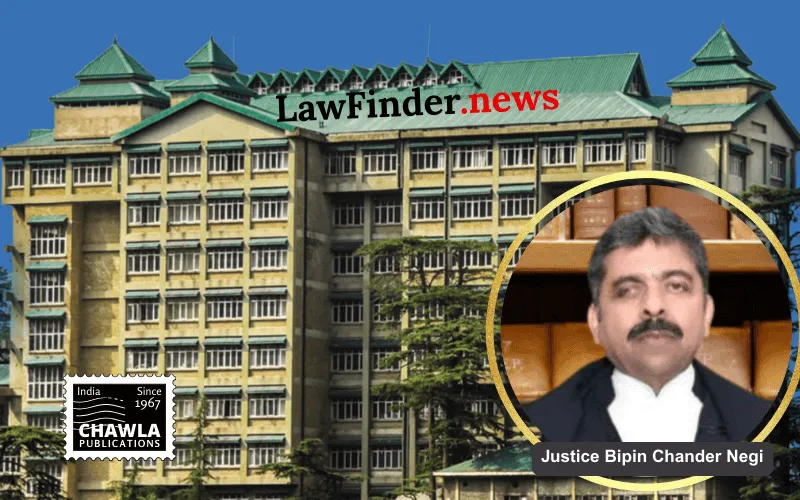
In a significant ruling, the Himachal Pradesh High Court, under Justice Bipin Chander Negi, upheld the decision of the District Judge (Family Court) Mand to close the evidence window for Supreety Jagota, the petitioner, due to repeated failure to present evidence. The judgment, rendered on January 1, 2026, underscores the judiciary's stance that courts are not obligated to wait indefinitely for parties to produce evidence, particularly when ample opportunities have been provided.
The case, involving Supreety Jagota and Hepesh Jagota, revolved around the petitioner's challenge against an order dated April 24, 2024, which barred her from leading further evidence. Despite numerous opportunities given by the trial court, the petitioner consistently failed to present any witnesses from December 2023 through April 2024.
The High Court observed that the petitioner attempted to justify her inability to produce evidence by citing non-payment of maintenance by the respondent, Hepesh Jagota. However, upon review, it was found that the maintenance payments had been made in accordance with the appellate court’s directives, rendering the petitioner's claim unfounded.
Justice Negi emphasized the principle that if a party consciously chooses not to lead evidence despite having multiple chances, it is bound to face the repercussions of such inaction. Citing the precedent set in Shamsher Singh v. Surat Singh, the court reiterated that it is not required to wait indefinitely for parties to comply with procedural obligations.
The judgment further clarified the limited scope of Article 227 of the Indian Constitution, which is confined to correcting grave derelictions of duty or blatant legal or justice violations. The court noted that this jurisdiction does not extend to re-evaluating evidence or rectifying every factual or legal error unless it results in a miscarriage of justice.
In conclusion, the High Court found no merit in Supreety Jagota's petition to invoke Article 227 and accordingly dismissed it. The parties are directed to appear before the trial court on January 16, 2026, to proceed with the case.
Bottom Line:
The court emphasized that if a party does not lead evidence despite repeated opportunities, the court is not obligated to wait indefinitely. Consequences of such deliberate inaction must be borne by the party. Furthermore, Article 227 jurisdiction is limited to correcting grave derelictions of duty or violations of fundamental principles of law and justice.
Statutory provision(s): Article 227 of the Constitution of India, Protection of Women from Domestic Violence Act, 2005 (Sections 12, 17, 19, 20, 22, 23)
Supreety Jagota v. Hepesh Jagota, (Himachal Pradesh) : Law Finder Doc Id # 2832112