Court dismisses appeal by J&K Board of School Education challenging charge allowance for deputed officer
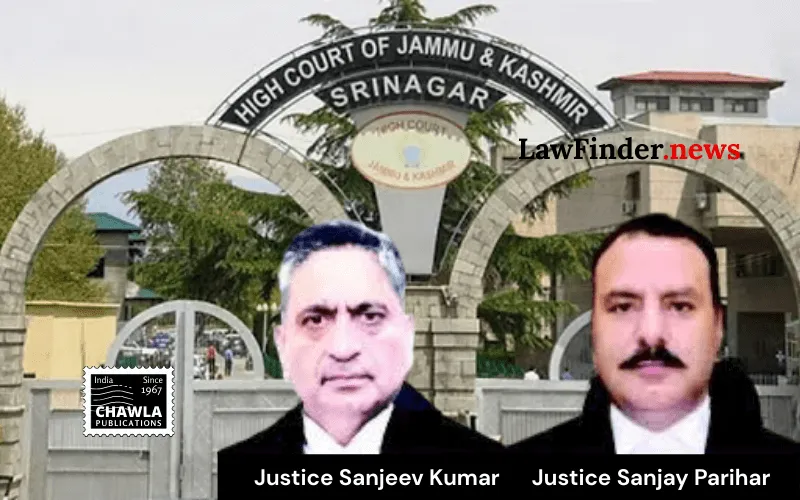
In a significant ruling, the Jammu and Kashmir High Court has upheld the entitlement of a government servant to receive compensation for duties performed in a higher office while on deputation to a statutory organization. The Division Bench, consisting of Justices Sanjeev Kumar and Sanjay Parihar, dismissed the appeal filed by the Chairman of the J&K Board of School Education against the decision of a Single Judge, which had quashed the recovery of charge allowance from the respondent, Syed Abdul Rouf.
The case arose from the deputation of Syed Abdul Rouf, who was originally serving as In-charge Chief Education Officer in the School Education Department, to the J&K Board of School Education to perform duties as In-charge Joint Secretary. The deputation was effected with the provision of charge allowance, as per standard rules, for a period of two years beginning in 2015.
The appellant, the J&K Board of School Education, contended that the respondent was holding the position in his own pay and grade, and was not entitled to any charge allowance, as the assignment did not involve performing duties within the line of promotion. The Board argued that the recovery order issued in 2017 was necessary to correct an erroneous payment and to rectify the financial loss to the public exchequer.
However, the High Court held that the respondent, having been tasked with duties of a higher office carrying greater responsibilities, was justified in receiving compensation, whether termed as charge allowance or deputation allowance. The Court clarified that while the respondent’s case was not strictly covered under the applicable regulations, compensation was warranted due to the nature of responsibilities undertaken outside his cadre.
The judgment emphasized that deputation allowances are applicable when government servants are transferred to statutory or autonomous bodies, and compensation for higher responsibilities is permissible even when the duties performed are outside the cadre. The decision underscores the importance of adhering to standard terms and conditions of deputation, while also recognizing the need to compensate officials for added responsibilities.
This ruling has broader implications for government servants on deputation, reaffirming their entitlement to fair compensation for duties requiring higher responsibilities and supporting the principle of equitable remuneration.
Bottom line:-
Deputation of a government servant to a higher post in a statutory/autonomous organization must comply with the standard terms and conditions of deputation under J&K CSR. Compensation for duties of a higher office, whether termed as charge allowance or deputation allowance, is permissible if duties are performed outside the cadre and involve higher responsibilities.
Statutory provision(s): J&K CSR Regulation 87, J&K CSR Regulations 22-D and 52-C