Court Rules Pension and Retiral Benefits as a Constitutional Right, Grants Interest on Delayed Payments
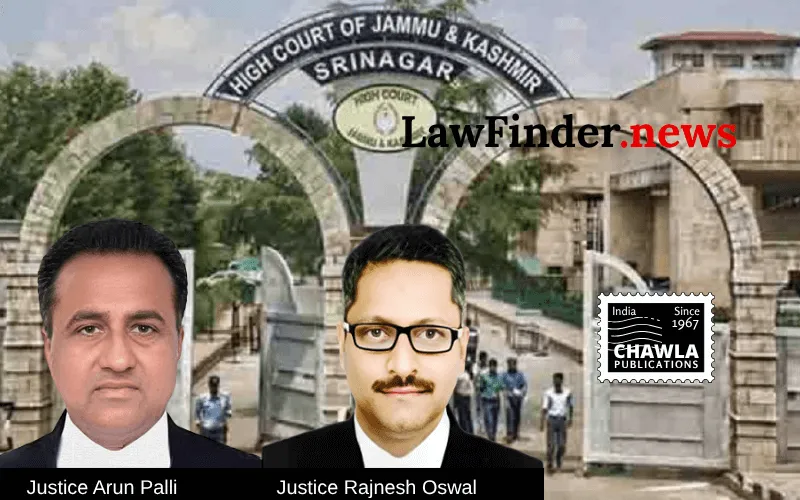
In a landmark judgment delivered on January 29, 2026, the Jammu and Kashmir High Court upheld the right to retiral benefits for Gulzar Ahmad Khan, despite allegations of his illegal appointment and regularization. The Division Bench, comprising Chief Justice Arun Palli and Justice Rajnesh Oswal, ruled that retiral benefits are a constitutional right protected under Article 300A of the Constitution of India, reinforcing that pension and other benefits are not mere bounties but hard-earned entitlements.
The case, titled Union Territory of J & K v. Gulzar Ahmad Khan, saw the appellants challenge the judgment of the Writ Court, which had previously directed the reconstruction of Khan’s service book and the release of all due retiral benefits. The appellants claimed that Khan’s appointment as a driver in 1999 and subsequent regularization in 2007 were illegal, thus disqualifying him from receiving these benefits. Despite the ongoing investigation by the Crime Branch, Kashmir, and an inquiry by the appellants, the High Court found no active judicial or departmental proceedings against Khan.
The High Court emphasized that the appellants' failure to act during Khan's service tenure, coupled with allowing him to retire without initiating any termination proceedings, nullified their claims of illegality. The court stated, "Retiral benefits are earned through long service and are not a matter of charity," underscoring the principle that pension is a right to property and cannot be withheld arbitrarily.
Additionally, the court addressed the issue of delayed payments, modifying the interest rate on overdue benefits from 7% to 6% per annum, as suggested by Khan’s counsel. The judgment mandates the appellants to comply with the directions within three months, failing which Khan will be entitled to interest from the date he first became eligible for these benefits.
This judgment reaffirms the legal precedent set by the Supreme Court in cases such as D.S Nakara v. Union of India and
State of Jharkhand v. Jitendra Kumar Srivastava, which recognize pension as a fundamental right rather than a discretionary allowance. The decision is expected to have significant implications for similar cases across the country, ensuring that employees are not deprived of their rightful benefits due to procedural delays or unsubstantiated allegations.
Bottom Line:
Retiral benefits and arrears cannot be denied to an employee after superannuation based on allegations of an illegal appointment or regularisation, especially when no timely action was taken against the employee during their service period. Pension and other retiral benefits are a right and cannot be withheld arbitrarily.
Statutory provision(s): Article 300A of the Constitution of India