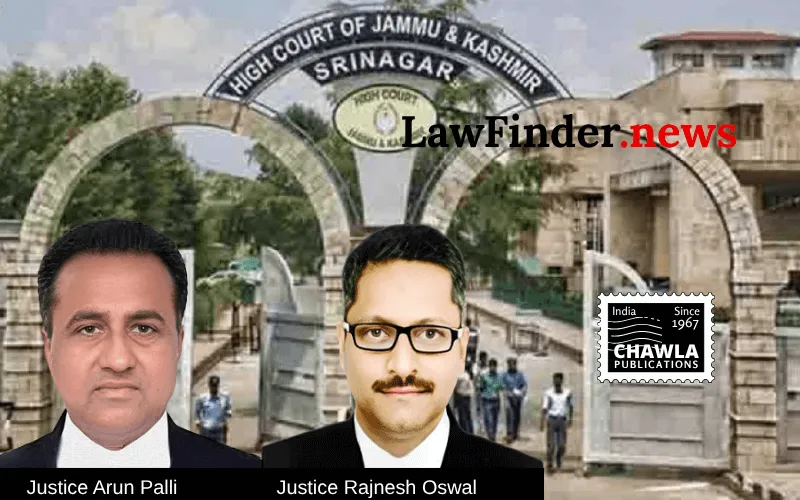
Court Allows Re-fixation of Pay/Pension Excluding Erroneous Benefits, Protecting Employees from Financial Hardship
In a significant ruling, the Jammu and Kashmir High Court has barred the recovery of excess payments made to Group-C and Group-D employees due to administrative errors. The decision, passed by a division bench comprising Chief Justice Arun Palli and Justice Rajnesh Oswal, addresses multiple writ petitions involving similar issues related to the recovery of excess payments and erroneous dual benefits granted to employees.
The case, "UT of J&K v. Maqbool Sheikh," revolved around the recovery of excess payments mistakenly made to employees due to dual benefits received under different Statutory Rules and Orders (SROs). The court held that recovering such payments would impose undue hardship on the employees, particularly those in lower service categories who often rely on their entire earnings for basic necessities.
The judgment drew upon principles of equity and referenced landmark Supreme Court decisions, including "State of Punjab v. Rafiq Masih" and "ITC Ltd. v. State of U.P." The court emphasized that while employees do not have a vested right to benefits granted erroneously, the recovery of such benefits should not be pursued if it results in severe hardship.
The court permitted the employer to re-fix the pay/pension of the employees by excluding the erroneously granted benefits, ensuring that the future pay scales align with the correct entitlements. However, the court prohibited any recovery of the excess amounts already disbursed, citing the principles of equity and the undue hardship recovery would cause.
In the judgment, the court also addressed the legal framework governing pension fixation and the limitations imposed by Government Instructions under the J&K Civil Service Regulations. It clarified that while the verification of emoluments is restricted to 24 months prior to retirement, this limitation does not apply to cases where dual benefits were erroneously granted.
The ruling has been hailed as a relief for Group-C and Group-D employees, who now stand protected from financial recovery actions that could have severely impacted their livelihoods. The court's decision underscores the importance of balancing administrative rectification with the equitable treatment of employees, particularly those in vulnerable service categories.
The judgment is expected to set a precedent for similar cases, ensuring that while administrative errors are corrected, the financial stability of lower-category employees is not compromised.
Bottom Line:
Recovery of excess payments made to Group-C and Group-D employees due to administrative errors barred; however, employer permitted to re-fix pay/pension excluding erroneously granted benefits.
Statutory provision(s): Article 242 of J&K Civil Service Regulations, SRO 14 of 1996, SRO 59, Government Instruction No. 1, Government Instruction No. 2, S.O. 129
UT of J&K v. Maqbool Sheikh, (Jammu And Kashmir)(DB) : Law Finder Doc id # 2862550