Court emphasizes the rule of alternative remedy, while permitting symbolic possession to balance statutory compliance and justice.
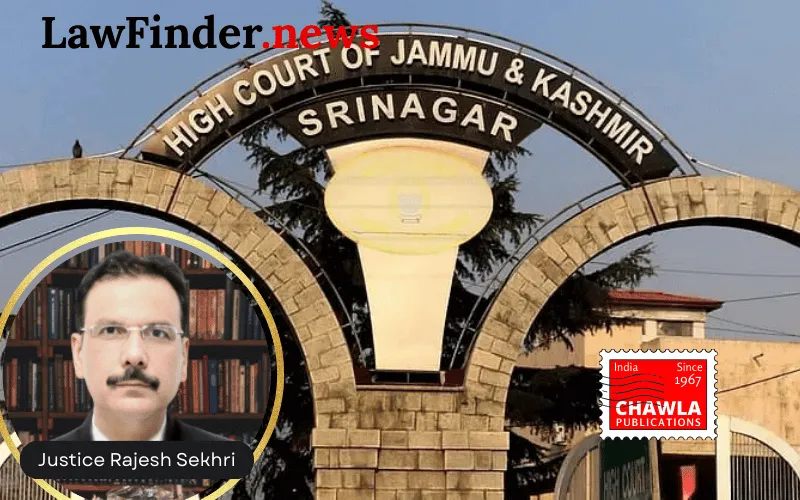
In a significant ruling, the Jammu and Kashmir High Court, under the bench of Justice Rajesh Sekhri, dismissed a writ petition filed by Farooq Ahmad Dar against the Union Territory of J&K and others. The petitioner sought to quash the order dated November 6, 2025, by the District Magistrate, Pulwama, which annulled a mutation and directed the Tehsildar to take possession of disputed land.
The petitioner bypassed the statutory remedy of appeal under the Jammu and Kashmir Immoveable Property (Preservation, Protection and Restraint on Distress Sales) Act, 1997, by directly approaching the High Court. The Court reiterated that writ jurisdiction under Article 226 of the Constitution is discretionary and should be exercised only in exceptional situations such as violation of fundamental rights or principles of natural justice, or lack of jurisdiction, which were not present in this case.
The Court noted that under Section 7 of the 1997 Act, an appeal against an order of eviction requires surrendering possession to the competent authority. However, considering the petitioner’s residential situation on the subject land, the Court allowed an equitable solution previously set in "Shabir Ahmad Rufai v. UT of J&K". This involves handing over symbolic possession, a legal arrangement that maintains the petitioner’s right to appeal without physical eviction.
The judgment emphasized that symbolic possession equates to actual possession in law, allowing the petitioner to pursue statutory appeal remedies while continuing to reside on the property. The petitioner must surrender symbolic possession within a week and file an undertaking to vacate if he fails in the appeal.
The Court has directed the appellate authority to expedite the appeal process within three months, ensuring a fair hearing for all parties involved. The interim order will remain effective until the appeal is filed.
This ruling underscores the judiciary's role in balancing statutory obligations with equitable justice, particularly in complex property disputes involving long-standing possession.
Bottom Line:
Rule of alternative remedy under Article 226 of the Constitution - High Court to entertain writ petition only in exceptional cases where statutory remedies are not efficacious or involve extraordinary circumstances.
Statutory provision(s): Article 226 of the Constitution of India, Jammu and Kashmir Immoveable Property (Preservation, Protection and Restraint on Distress Sales) Act, 1997, Section 7