Court Upholds Rule of Alternative Remedy, Directs Petitioner to Appeal Under CGST Act
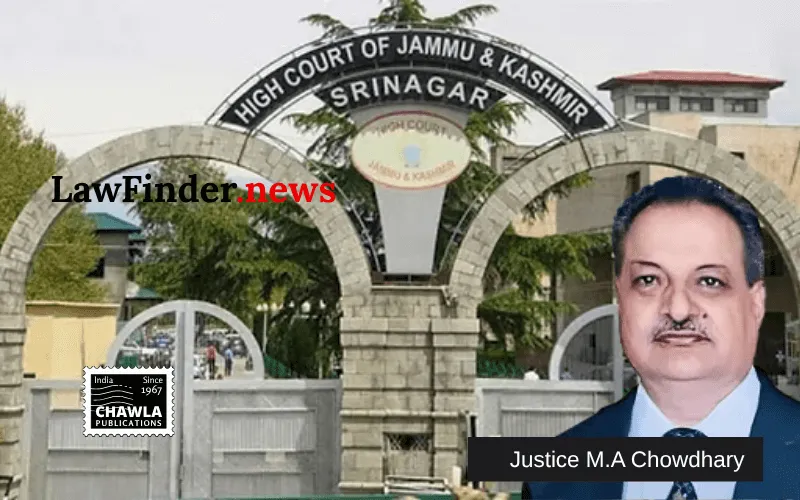
The Jammu and Kashmir High Court, in a significant ruling, dismissed the writ petition filed by M/S Ess Ess Enterprises and Electronics FF, challenging a demand order issued under Section 73 of the Jammu and Kashmir Goods and Services Tax Act, 2017. The court emphasized the availability of an alternative statutory remedy under Section 107 of the Central Goods and Services Tax Act, 2017 (CGST Act), which bars the maintainability of a writ petition under Article 226 of the Constitution, except in specific exceptions.
The petitioner, represented by senior advocate Mr. Azhar ul Amin, contended that the demand order violated the principles of natural justice and was issued without jurisdiction. The petitioner argued that a show cause notice was issued while she was out of the Union Territory, and the personal hearing date coincided with a public holiday, thus preventing her from attending.
However, the Division Bench, comprising Justices Mr. Sanjeev Kumar and Mr. Wasim Sadiq Nargal, noted that the petitioner failed to utilize multiple opportunities to file a reply or attend hearings, thereby negating the claim of natural justice violation. Furthermore, the court found the jurisdictional challenge unfounded, citing Section 65(7) of the CGST Act, which permits the proper officer to initiate action under Sections 73 or 74 following an audit that detects tax discrepancies.
The court reiterated the principles established by the Supreme Court in cases like Whirlpool Corporation v. Registrar of Trade Marks and Radha Krishan Industries v. State of Himachal Pradesh. It highlighted that the High Court's writ jurisdiction should not be exercised when an efficacious alternative remedy exists, unless exceptions such as a fundamental rights violation, lack of jurisdiction, or principles of natural justice breach are evident.
In its judgment, the High Court dismissed the petition as not maintainable and directed the petitioner to pursue the statutory appeal route under Section 107 of the CGST Act. The court clarified that its observations were limited to the dismissal order and not a final decision on the merits of the case, allowing the petitioner to raise contentious issues before the appellate authority.
This decision underscores the judiciary's stance on adhering to statutory remedies and reinforces the procedural framework within the GST regime, ensuring taxpayers follow the prescribed appellate processes.
Bottom line:-
Availability of an alternative statutory remedy under Section 107 of the CGST Act/J&K GST Act bars the maintainability of a writ petition under Article 226 of the Constitution, except in specific exceptions such as violation of principles of natural justice or lack of jurisdiction.
Statutory provision(s):
Article 226 of the Constitution of India, Section 107 of the CGST Act, Section 73 of the J&K GST Act, Section 65 of the CGST Act.