Court advises petitioner to approach the appropriate jurisdiction, emphasizing the importance of substantial cause of action within territorial limits
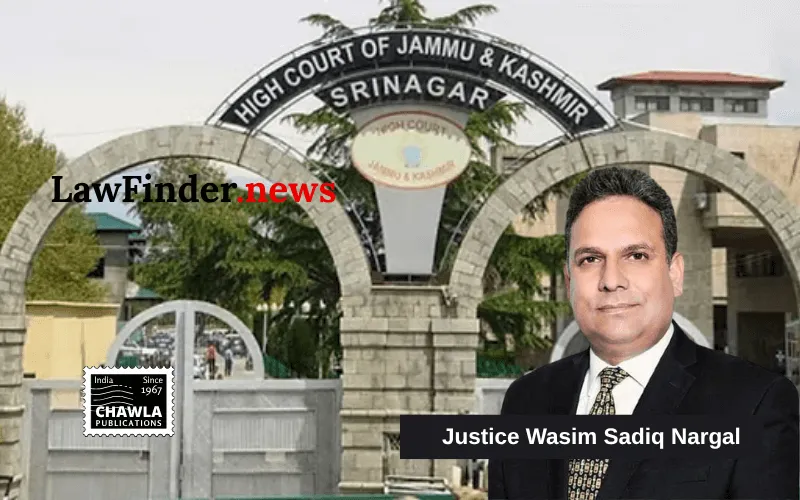
In a significant ruling on February 25, 2026, the Jammu and Kashmir High Court, presided over by Justice Wasim Sadiq Nargal, dismissed a writ petition filed by Noshad Ahmed against the Union of India and others. The petitioner, who had been removed from service in the Central Reserve Police Force (CRPF) for alleged misconduct, sought to quash his dismissal and other related orders. However, the court found that it lacked the territorial jurisdiction to entertain the case, as no substantial part of the cause of action arose within its territorial limits.
The court highlighted that the incident leading to the petitioner's dismissal occurred in New Delhi, with subsequent appeals and revisions being handled in Jalandhar and Chandigarh, respectively. Justice Nargal emphasized that the mere service of orders at the petitioner’s residence in Jammu and Kashmir does not constitute a substantial part of the cause of action, referencing Supreme Court precedents such as Oil and Natural Gas Commission v. Utpal Kumar Basu and Kusum Ingots & Alloys Ltd. v. Union of India.
The judgment underscored the principle that territorial jurisdiction must be based on material and integral aspects of the cause of action, not merely on procedural or incidental factors like the service of communication. Justice Nargal cautioned against forum shopping and reiterated that jurisdiction cannot be dictated by the unilateral actions of the petitioner.
While dismissing the petition for lack of jurisdiction, the court provided a reprieve to Noshad Ahmed, allowing him the opportunity to file his petition in a court with appropriate jurisdiction. The time spent pursuing the case in the wrong forum will not prejudice his ability to seek relief elsewhere.
The case reinforces the judicial principle that jurisdiction is anchored in the substantive elements of a dispute, rather than the location of the parties involved.
Bottom Line:
Territorial jurisdiction - High Court cannot entertain a writ petition where no substantial part of the cause of action has arisen within its territorial limits.
Statutory provision(s): Article 226 of the Constitution of India, Section 11(1) of the CRPF Act, 1949, Rule 27 of the CRPF Rules, Rule 14 of the CCS (CCA) Rules, 1965
Noshad Ahmed v. Union of India, (Jammu And Kashmir) : Law Finder Doc id # 2859439