Private property disputes cannot be adjudicated under Article 226, court reiterates
In a significant judgment, the Jammu and Kashmir High Court dismissed a writ petition filed by Abdul Gani Ganie and others challenging the mutation of inheritance of land in Baramulla district. The petitioners, claiming to be legal heirs of late Mst. Mukhti and Qadir Ganie, sought quashment of Mutation No. 267 dated January 30, 1995, and subsequent orders passed by the Financial Commissioner (Revenue), J&K, which dismissed their revision and review petitions.
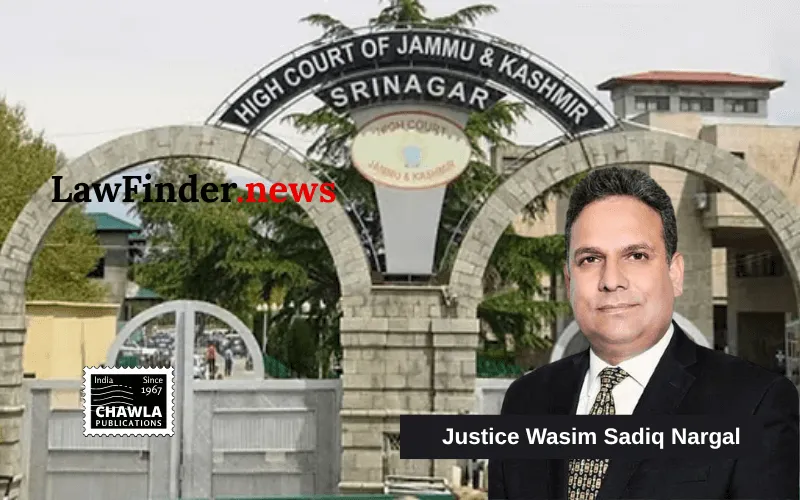
Presiding Judge Mr. Wasim Sadiq Nargal held that writ jurisdiction under Article 226 of the Constitution of India is primarily meant for enforcing public law rights and public duties. The court emphasized that disputes purely private in nature, such as those arising from inheritance, private settlements, or personal obligations, do not fall within the purview of writ jurisdiction and must be adjudicated in civil courts or competent statutory authorities.
The petitioners argued that the orders passed by the Financial Commissioner were procedurally flawed and violated principles of natural justice, as the question of limitation was raised without prior notice. They contended that the mutation was attested in violation of Muslim Personal Law and Standing Order 23-A, and should be open to challenge at any time.
However, the court found no merit in these arguments, underscoring that the question of limitation is a pure question of law that goes to the root of maintainability. It held that courts are duty-bound to examine limitation suo motu, even if not argued by the parties, and that entertaining stale claims would unsettle settled rights and cause prejudice to the opposite party.
The judgment also highlighted procedural defects in the petition, such as the non-impleadment of necessary parties, which rendered effective adjudication impossible. The court ruled that any order passed without the decision-making authority as a respondent would be unenforceable.
Ultimately, the court dismissed the writ petition as not maintainable, advising the petitioners to seek remedies through civil courts where evidence can be thoroughly examined. The decision reaffirms the limited scope of writ jurisdiction in private property disputes and emphasizes the importance of adhering to procedural norms and limitation periods.
Bottom Line:
Writ jurisdiction under Article 226 of the Constitution of India cannot be invoked for adjudicating private disputes concerning inheritance, private settlements, and mutation of property, as it does not involve public law elements or statutory duties.
Statutory provision(s): Article 226 of the Constitution of India, Limitation Act, 1963 Section 3
Abdul Gani Ganie v. Habib Ullaha Ganie, (Jammu And Kashmir)(Srinagar) : Law Finder Doc Id # 2824487