Court Finds Government Order on Territorial Jurisdiction Changes Unconstitutional Without Statutory Notification
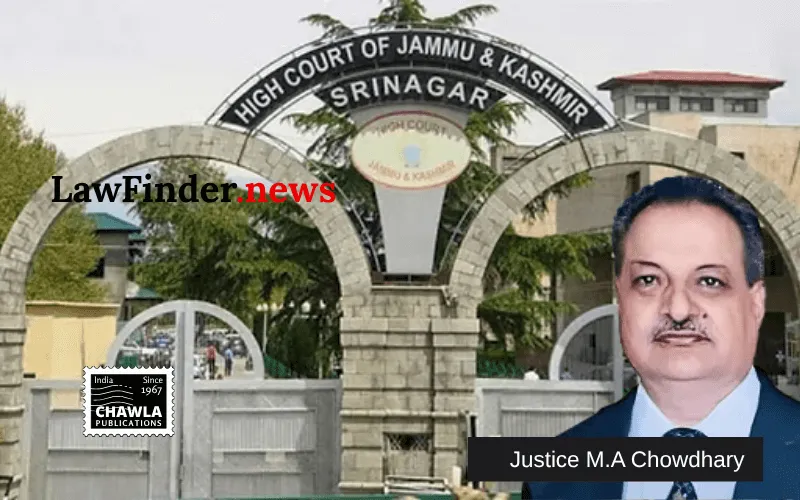
In a significant ruling, the Jammu and Kashmir High Court has quashed a government order that sought to alter the territorial jurisdiction of administrative units without a statutory notification, citing the necessity of adherence to statutory procedures and consideration of local residents' convenience. The case, titled "Omesh Singh v. State (now UT) of Jammu & Kashmir," was presided over by Justice M A Chowdhary.
The petitioners, including Omesh Singh, challenged the inclusion of Revenue Village Dhanmasta into Niabat Neel and Tehsil Ramsoo from its original jurisdiction under Niabat Ukhral, Tehsil Pogul Paristan, asserting that the government order was unconstitutional, illegal, and arbitrary. They argued that such a change required a formal statutory notification under Section 5 of the Land Revenue Act, which was not issued.
The court highlighted that the government must issue a statutory notification when altering the limits of administrative units, as prescribed by the Land Revenue Act, Svt. 1996. The absence of such a notification rendered the government's order unsustainable. The court emphasized the importance of considering local residents' convenience, including topography, geographical contiguity, and accessibility, when reorganizing administrative units.
The petitioners presented evidence showing that Village Dhanmasta was geographically closer to the headquarters at Ukhral and that the reorganization would cause significant inconvenience, particularly during adverse weather conditions. The court concurred, noting that the government's decision lacked proper consideration of these factors.
In its judgment, the court underscored that while the executive has the prerogative to set administrative boundaries, it must do so within the framework of statutory provisions and in consideration of local needs. The decision to quash the government order was based on the lack of statutory compliance and the failure to objectively assess the impact on the local population.
The court directed the government to re-examine the matter, allowing for statutory provisions to be made if necessary, and ensuring that the affected inhabitants are given an opportunity to be heard. Until such measures are taken, Village Dhanmasta will remain under the jurisdiction of Niabat Ukhral and Tehsil Pogul Paristan.
This judgment reaffirms the judiciary's role in ensuring that administrative decisions comply with statutory requirements and reflect the needs and conveniences of the local populace.
Bottom Line:
Administrative reorganization - Impugned government order altering the territorial jurisdiction of administrative units quashed for lack of statutory notification and proper consideration of convenience and accessibility for local residents.
Statutory provision(s): Section 5 of the Land Revenue Act, Svt. 1996
Omesh Singh v. State (now UT) of Jammu & Kashmir, (Jammu And Kashmir) : Law Finder Doc id # 2861636