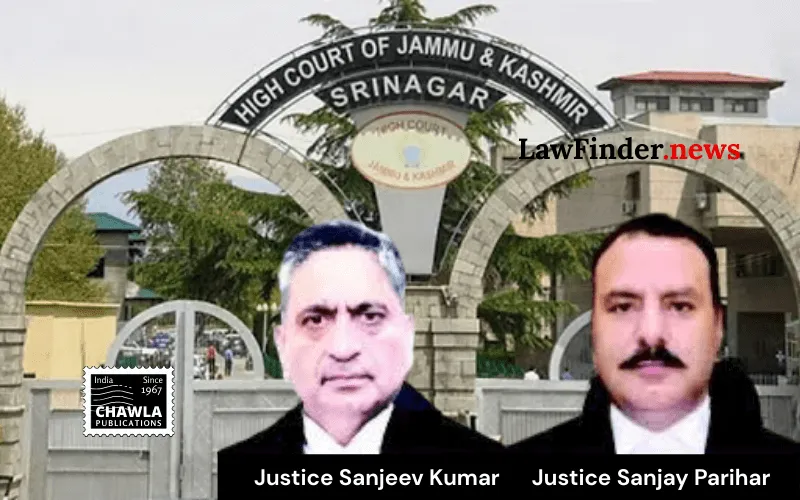
Judgment Mandates FFRC to Align with Supreme Court Directives; Calls for Retired High Court Judge as Chairperson
In a landmark judgment dated January 28, 2026, the Jammu and Kashmir High Court has addressed significant concerns regarding the regulation of fees in private unaided educational institutions within the Union Territory. The judgment, delivered by Mr. Sanjeev Kumar and Mr. Sanjay Parihar, JJ., provides directives aimed at aligning the Fee Fixation and Regulation Committee (FFRC) with constitutional mandates and Supreme Court judgments, particularly those laid down in the cases of T.M.A. Pai Foundation and Islamic Academy of Education.
The court scrutinized several amendments made to the J&K School Education Act, 2002, which empowered the FFRC to regulate fee structures. The private unaided schools challenged these amendments, asserting that they imposed unreasonable restrictions on their autonomy, contrary to Supreme Court rulings that have consistently recognized the right of such institutions to set their own fee structures, subject to preventing commercialization and profiteering.
One of the critical aspects of the judgment was the provision allowing a Government Officer of the rank of Financial Commissioner or above to be appointed as Chairperson of the FFRC. The court held this provision as contrary to the Supreme Court's directives, which require the appointment of a retired High Court Judge nominated by the Chief Justice, ensuring the committee's independence from executive influence. Consequently, the judgment directed the replacement of this provision with a mandatory requirement for a retired High Court Judge to head the FFRC.
The judgment also dealt with the regulation of transport fees charged by private schools. It directed the FFRC to constitute a committee involving the transport and consumer affairs departments to recommend guidelines for transport fee fixation. Until these guidelines are finalized, an interim arrangement will continue.
Furthermore, the court urged the government to revisit and refine the Private Schools (Fixation, Determination and Regulation of Fee) Rules, 2022, to ensure they align with constitutional mandates without stifling the autonomy of private schools, especially those in rural areas. The judgment recognized the significant role played by private schools in the Union Territory's education system, given the challenges faced by public schools.
This decision underscores the balancing act between regulating educational institutions to prevent exploitation and allowing them sufficient autonomy to operate effectively. It aims to foster an environment where private schools can thrive without undue interference, while ensuring they do not engage in profiteering at the expense of quality education.
Bottom Line:
Regulation of fees in private unaided educational institutions - Amendments to the J&K School Education Act, 2002, and the establishment of the Fee Fixation and Regulation Committee (FFRC) - Provisions empowering FFRC to regulate and determine fee structures must align with Supreme Court judgments and constitutional mandates.
Statutory provision(s): Articles 19(1)(g), 21, 41, 45 of the Constitution of India; Sections 20A to 20J of the J&K School Education Act, 2002