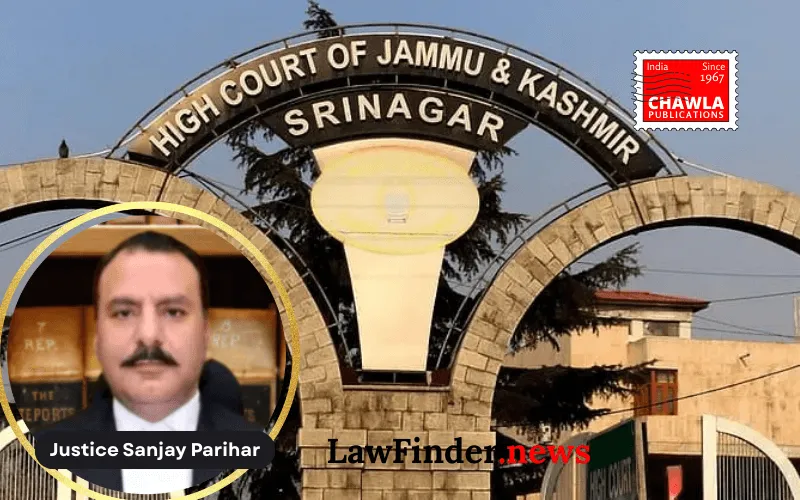
Court Upholds Administrative Decision, Citing Lack of Seniority and Legal Framework for Regularization
In a significant ruling, the Jammu and Kashmir High Court has dismissed the writ petition filed by Mohammad Amin Rather and others seeking parity with permanent casual labourers. The petitioners, engaged as seasonal labourers since 1998, had sought similar status and benefits extended to a select group of employees under the respondent department. The judgment, pronounced by Justice Sanjay Parihar, underscores the necessity for a rational basis in classification and the adherence to statutory guidelines when considering regularization in public employment.
The petitioners contended that their long service warranted equal treatment to respondents who were granted year-round engagement and permanent casual labourer status. They argued that the rejection of their claim violated the principles of equality under Articles 14 and 16 of the Constitution of India by creating an artificial classification among similarly situated employees.
However, the respondents maintained that the petitioners were employed purely on a seasonal basis during irrigation periods and did not meet the eligibility criteria outlined in SRO 520 of 2017. They further highlighted a government-imposed blanket ban on new engagements and emphasized that the adjustment of certain individuals into permanent roles was driven by seniority and administrative needs.
Justice Parihar, after reviewing the arguments and records, ruled that the petitioners failed to demonstrate a complete identity in terms of seniority and nature of duties with those who were regularized. The court reiterated that arbitrariness is antithetical to equality but emphasized that positive equality under Article 14 does not envisage perpetuation of illegality or confer enforceable rights contrary to statutory frameworks.
The judgment drew upon precedents from landmark Supreme Court cases, including E.P. Royappa v. State of Tamil Nadu and State of Karnataka v. Umadevi (3), which emphasize the constitutional scheme in public employment and the limited scope of judicial review regarding executive decisions unless shown to be arbitrary or mala fide.
Justice Parihar noted that the petitioners did not make a compelling case for judicial intervention, as the differential treatment was based on reasonable administrative exigencies. The court upheld the respondents' stance that the non-regularization was consistent with legal and administrative norms.
The decision underscores the judiciary's role in maintaining the sanctity of public employment rules and refraining from encroaching upon executive policy decisions. It also highlights the importance of seniority and administrative requirements as legitimate grounds for employment decisions.
Bottom line:-
Service Law - Seasonal labourers cannot claim parity with permanent casual labourers without demonstrating complete identity in terms of seniority, nature of duties, and administrative requirements.
Statutory provision(s): Articles 14, 16, and 226 of the Constitution of India
Mohammad Amin Rather v. UT of J&K, (Jammu And Kashmir)(Srinagar) : Law Finder Doc id # 2897245