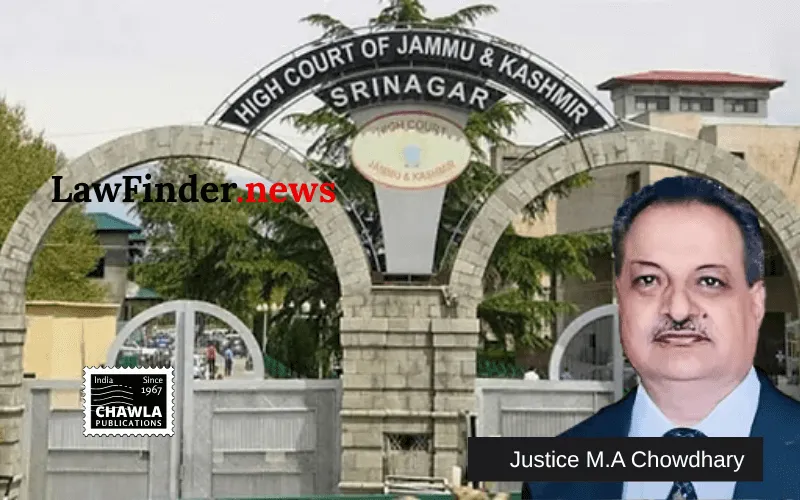
Court Directs Compensation or Restoration of Land Occupied Without Due Process for Over 70 Years
In a significant judgment, the Jammu and Kashmir High Court, presided over by Justice M.A. Chowdhary, has reinforced the constitutional right to property, directing the National Highway Authority of India (NHAI) to either compensate the rightful owners or restore possession of land that has been occupied for over seven decades without following the due process of law. The case, titled "Ch. Mohd. Sadiq v. Union of India," revolved around a petition filed by Ch. Mohd. Sadiq, whose ancestral land in Village Digiana, Jammu, was utilized for the widening of the Jammu-Pathankot National Highway without any legal acquisition or compensation since 1957.
The land in question, measuring 2 kanals, was initially occupied by the Central Public Works Department (CPWD) and subsequently transferred to the State Public Works Department (PWD) and later to the NHAI. Despite the land being utilized for public purposes, no acquisition proceedings were conducted, nor was any compensation paid to the petitioner or his predecessors, a situation the court deemed impermissible under Article 300A of the Indian Constitution.
The court highlighted that the right to property, though no longer a fundamental right, remains a constitutional and human right. Referring to precedents set by the Supreme Court, Justice Chowdhary emphasized that deprivation of property without due process is a violation of constitutional rights and principles of natural justice.
The court's judgment mandates the NHAI to initiate acquisition proceedings for the land or restore it to the rightful owners within six weeks from receiving the court's certified order. The Collector/Competent Authority is instructed to carry out the acquisition process in accordance with the law and within the stipulated timeline.
This ruling underscores the judiciary's role in safeguarding citizens' rights against unauthorized governmental encroachments and reinforces the legal obligation to compensate for land acquired for public use.
Bottom Line:
Right to Property - Land utilized without acquisition proceedings or compensation - Held, right to property is a constitutional right under Article 300A and a human right; landowners cannot be deprived of their property without following due process of law.
Statutory provision(s):
Article 300A of the Constitution of India, Right to Fair Compensation and Transparency in Land Acquisition, Rehabilitation and Resettlement Act, 2013
Ch. Mohd. Sadiq v. Union of India, (Jammu And Kashmir) : Law Finder Doc id # 2857888