Court dismisses plea for quashing FIR despite previous departmental inquiry closure, emphasizing mandatory registration upon discovery of cognizable offence.
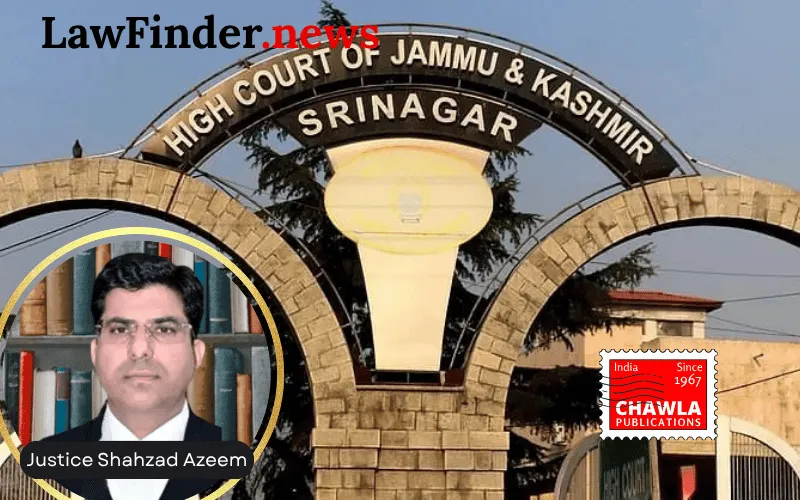
In a significant judgment delivered by the Jammu and Kashmir High Court on May 6, 2026, the court dismissed a petition seeking the quashing of FIR No. 09 of 2015 against Aijaz Hussain Sahaf, a former Executive Engineer, accused of forgery and manipulation of official records. The judgment, presided over by Justice Shahzad Azeem, underscores the legal obligation to register an FIR when new evidence suggests the commission of a cognizable offence, even if a prior preliminary inquiry recommended closure.
The petitioner, Aijaz Hussain Sahaf, was alleged to have altered his date of birth in his service book from 28 August 1955 to 28 August 1958, thereby extending his tenure in office. Initially, a preliminary inquiry by the Crime Branch concluded with a recommendation for closure, but subsequent departmental inquiries and new evidence led to the registration of the FIR under Sections 420, 467, 468, and 471 of the Ranbir Penal Code.
The court reiterated that the preliminary inquiry's closure was non-conclusive and emphasized that fresh material gathered during investigation indicated prima-facie commission of cognizable offences, mandating the registration of an FIR under Section 154 of the Criminal Procedure Code. The judgment clarified that the High Court's inherent jurisdiction under Section 561-A CrPC cannot be invoked to quash an FIR solely based on previous inquiry recommendations, especially when substantial evidence exists.
The court noted the collection of critical evidence, including matriculation certificates, service-book records, and forensic reports, which corroborated the allegations against Sahaf. A forensic science laboratory (FSL) report confirmed discrepancies in the service record, further substantiating the charges of forgery.
Additionally, the court addressed the distinction between disciplinary proceedings and criminal proceedings, stating that exoneration in departmental inquiries does not automatically lead to quashing criminal charges, which require proof beyond reasonable doubt.
The judgment dismissed Sahaf's contention that the FIR was motivated by malice or lodged by an incompetent officer, stressing the presumption of regularity in official acts unless proven otherwise.
In conclusion, the Jammu and Kashmir High Court's ruling highlights the procedural integrity in criminal investigations, ensuring that cognizable offences are thoroughly examined and prosecuted. This decision reinforces the judiciary's role in upholding the rule of law and preventing abuse of legal processes.
Bottom line:-
Quashing of FIR - High Court cannot quash an FIR under its inherent jurisdiction merely because a preliminary verification had earlier recommended closure, when subsequent material collected during investigation discloses commission of a cognizable offence.
Statutory provision(s): Section 561-A of CrPC, Section 154 of CrPC, Sections 420, 467, 468, 471 of Ranbir Penal Code.
Aijaz Hussain Sahaf v. State of J&K, (Jammu And Kashmir)(Srinagar) : Law Finder Doc id # 2894097