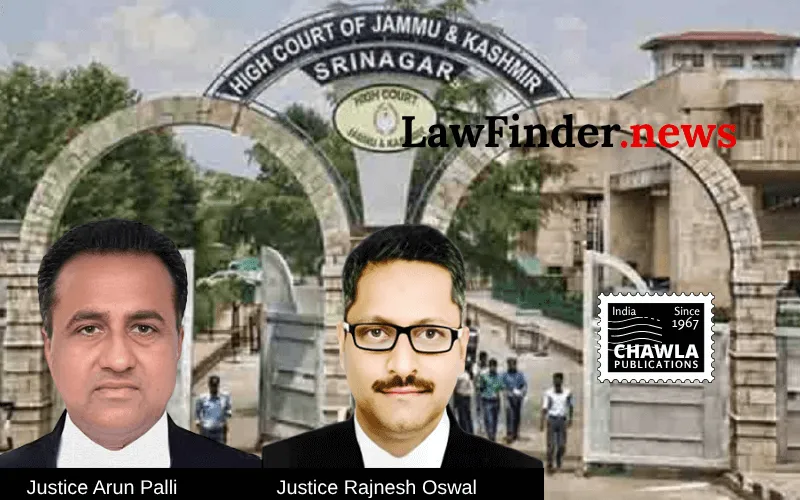
Court affirms that treating maternity leave as a break in service is discriminatory, ensuring women's rights under the Constitution and Maternity Benefit Act.
In a landmark judgment, the Jammu and Kashmir High Court ruled that maternity leave should be considered as continuous service for women employees, thereby dismissing the appeals filed by Jammu and Kashmir Bank Ltd. The court emphasized that treating maternity leave as a break in service constitutes systemic gender discrimination and violates constitutional provisions ensuring equality and dignity for women.
The bench, comprising Chief Justice Arun Palli and Justice Rajnesh Oswal, upheld the previous decision that directed the bank to consider the period spent on maternity leave as continuous service for the purpose of regularisation and retrospective benefits. The appeals, LPA No. 27/2026 and LPA No. 34/2026, challenged the judgment on the grounds that the respondents' contractual terms were extended due to maternity leave, delaying their regularisation.
The court highlighted constitutional articles 14, 15, 38, and 42, which collectively aim to eliminate gender discrimination and promote equality. It further noted that the Maternity Benefit Act, 1961, ensures that women are not deprived of their livelihoods during pregnancy and post-natal periods, providing full remuneration and health security.
The judgment underlines the duty of the State as a model employer to protect its employees' rights and uphold constitutional mandates. It criticized the bank for its failure to act fairly and equitably, stressing that such practices against female employees are impermissible.
This decision reinforces the judiciary's stance on gender justice and equality, ensuring that motherhood is not penalized in the professional realm. The court's ruling is expected to have far-reaching implications for employment practices concerning maternity leave across the country.
Bottom line:-
Maternity leave must not be treated as a break in service for purposes of regularisation and retrospective benefits, as doing so amounts to gender discrimination and contravenes constitutional provisions ensuring equality and dignity for women.
Statutory provision(s): Article 14, Article 15, Article 15(3), Article 38, Article 42 of the Constitution of India, Maternity Benefit Act, 1961
Jammu and Kashmir Bank Ltd. v. Tanu Gupta, (Jammu And Kashmir)(DB) : Law Finder Doc id # 2902530