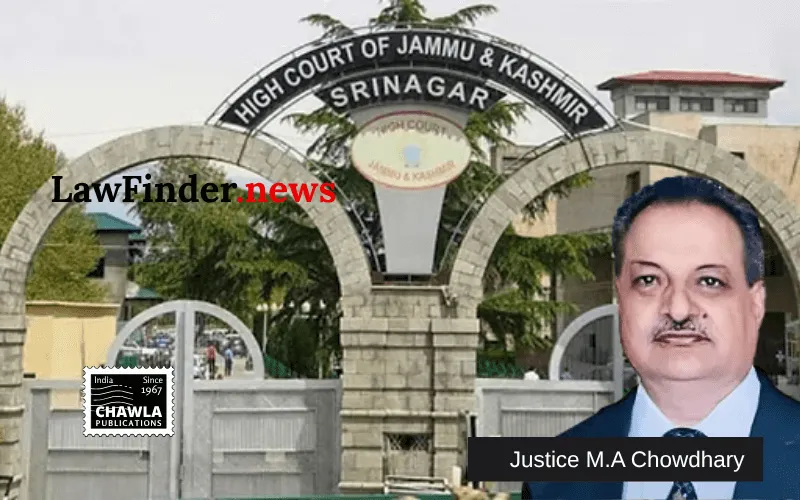
Court Dismisses Petition Against Recovery of Penalties for Failure to Complete Black-Topping in Godown Project
In a recent judgment, the Jammu and Kashmir High Court, presided over by Justice M. A. Chowdhary, dismissed a petition filed by M/S Alpine Agro Services challenging the recovery of penalties imposed by the Food Corporation of India (FCI). The penalties were levied due to delays in completing the black-topping of internal roads at a godown constructed under the Private Entrepreneur Guarantee (PEG) Scheme in Srinagar.
The petitioner, Alpine Agro Services, had entered into a contract with FCI for constructing a godown with a capacity of 17,500 MT. Despite completing the construction, the petitioner failed to finish the black-topping of internal roads within the stipulated timeframe. This led to FCI imposing penalties based on policy decisions made by a High Level Committee, which were uniformly applied across similar cases nationwide.
Alpine Agro Services argued that the delay was due to circumstances beyond their control, including the demise of a partner and the volatile law and order situation in Kashmir in 2016. However, the court found that these justifications were not tenable since the extension for completing the work expired before the disturbances began.
The court highlighted that the petitioner had accepted the contract terms and derived benefits, thus estopping them from disputing the liabilities. Justice Chowdhary emphasized that the recovery was compensatory, aligning with the policy to ensure fairness and non-arbitrariness in contractual obligations involving state entities like FCI.
Citing previous Supreme Court rulings, the court maintained that the writ jurisdiction was not barred merely due to the contractual nature of the dispute. However, it concluded that Alpine Agro Services had no grounds to challenge the penalties as they had not contested the foundational decisions of the High Level Committee.
The judgment reaffirms the principle that parties who benefit from contracts must also adhere to their obligations, and penalties for breaches are enforceable, particularly when uniformly applied and aligned with policy decisions.
Bottom line:-
Recovery of penalty for delayed completion of contractual obligations - A contracting party is estopped from disputing liabilities after accepting benefits under the same contract. Recovery based on policy decisions uniformly applied across the country is not arbitrary or violative of principles of natural justice.
Statutory provision(s): Article 226 of the Constitution of India, Doctrine of Election and Estoppel, Contract Law Principles