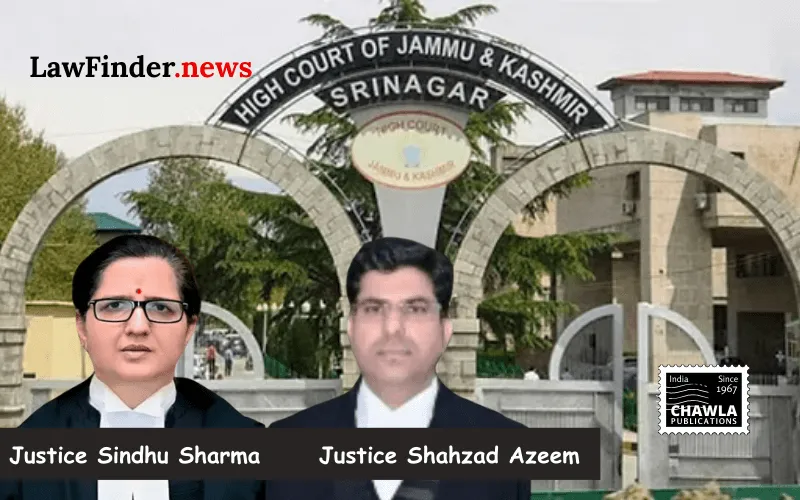
Court Dismisses State's Appeal Against Tribunal's Order, Citing Violation of Constitutional Rights
In a significant ruling, the Jammu and Kashmir High Court has upheld the decision of the Central Administrative Tribunal, ordering the regularization of services for a deceased employee, Mohd. Rafi Khan, whose widow, Sara Begum, sought the recognition for family benefits. The court dismissed the appeal by the State (now Union Territory) of Jammu and Kashmir, which challenged the tribunal's directive to regularize the deceased's employment and grant consequent benefits.
Mohd. Rafi Khan had been engaged as a Junior Assistant on a stop-gap basis since November 26, 1993, and had served continuously until his death on December 14, 2014. Despite an Empowered Committee's recommendation for his regularization under the Jammu and Kashmir Civil Services (Special Provisions) Act, 2010, his name was excluded from the final regularization order issued in January 2013, while his juniors were regularized.
The court, comprising Justices Mrs. Sindhu Sharma and Shahzad Azeem, observed that the State's action of leaving out Khan's name from regularization despite over two decades of service amounted to hostile discrimination and violated Articles 14 and 16 of the Constitution of India, which ensure equality and non-discrimination in public employment.
The State's argument that Khan's service could not be regularized due to the repeal of the Act of 2010 and the absence of statutory rules post-repeal was rejected by the court. It ruled that rights accrued under the repealed Act could not be retrospectively annulled, emphasizing that the repeal could not defeat crystallized rights.
The court further criticized the State's "hire and fire" policy, stressing that a welfare state must act with fairness and compassion, especially when an employee has served continuously for such an extended period. The judgment underscored the State's obligation to lead by example and avoid exploitative engagements.
The High Court found no merit in the State's appeal and upheld the tribunal's pragmatic view, thereby directing the regularization of Khan's services with effect from January 11, 2013, the date when his juniors were regularized, and ordered the release of all consequential benefits, including arrears, allowances, family pension, and other statutory dues to his widow.
Bottom Line :-
Regularization of services - State cannot discriminate against an employee who has rendered continuous and uninterrupted service for over two decades, even if initially engaged on adhoc or temporary basis - Right accrued under a repealed Act cannot be taken away retrospectively.
Statutory provision(s):
Articles 14 and 16 of the Constitution of India, Jammu and Kashmir Civil Services (Special Provisions) Act, 2010.