Court affirms validity of extended investigation period under NDPS and UAPA, dismissing appeal for default bail
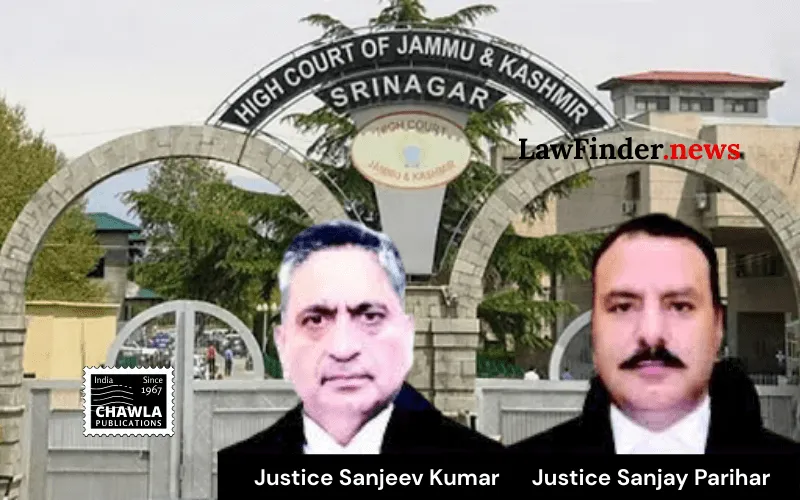
The Jammu and Kashmir High Court, in a significant ruling, dismissed the appeal of Riyaz Ahmad Hajam and another, challenging the denial of default bail by the Special Court for NIA/UAPA in Baramulla. The division bench, comprising Justices Sanjeev Kumar and Sanjay Parihar, upheld the trial court's orders dated 27th May 2022 and 14th December 2021, which rejected the appellants' plea for default bail in a high-profile narco-terror case.
The case originated from the interception of a vehicle in June 2021, leading to the recovery of arms, grenades, contraband heroin, and cash, which implicated Hajam and several others in activities linked to narco-terror financing. The appellants contended that the charge-sheet was not filed within the statutory period, thereby entitling them to default bail.
However, the High Court found that the prosecution had filed a valid charge-sheet within the extended statutory period. The court emphasized that the extension of the investigation period was legally sanctioned under Section 36A of the Narcotic Drugs and Psychotropic Substances (NDPS) Act, given the complexity and ongoing nature of the investigation. The court also noted that both the NDPS Act and the Unlawful Activities (Prevention) Act (UAPA) are special enactments that must be harmoniously construed, especially in cases involving overlapping offenses.
The appellants argued that the extension was sought on mala fide grounds and that the supplementary charge-sheets filed by the prosecution were merely an attempt to circumvent their right to default bail. They also questioned the jurisdiction of the trial court to extend the investigation period under the NDPS Act when the UAPA was also applicable.
Rejecting these arguments, the court clarified that the trial court was competent to extend the investigation period under the NDPS Act, as it was also designated as a Special Court for UAPA matters. The court further stated that the existence of Section 48 of the UAPA does not automatically negate the applicability of Section 36A of the NDPS Act, thus reinforcing the legitimacy of the procedural extensions granted.
The court's decision underscores the legal principle that once a valid charge-sheet is filed within the prescribed or legally extended period, the accused's right to default bail is extinguished, irrespective of whether cognizance is taken thereafter. This judgment reiterates the judiciary's stance on maintaining the integrity of legal proceedings in cases involving serious allegations of narco-terrorism.
Bottom line:-
Statutory/default bail under Section 167(2) CrPC read with Section 43D of the UAPA cannot be claimed if the prosecution has filed a valid charge-sheet within the prescribed or legally extended period. The provisions of NDPS Act and UAPA, being special enactments operating in distinct legislative fields, must be harmoniously construed.
Statutory provision(s): Section 167(2) CrPC, Section 43D of the UAPA, Section 36A of the NDPS Act, Section 173(8) CrPC