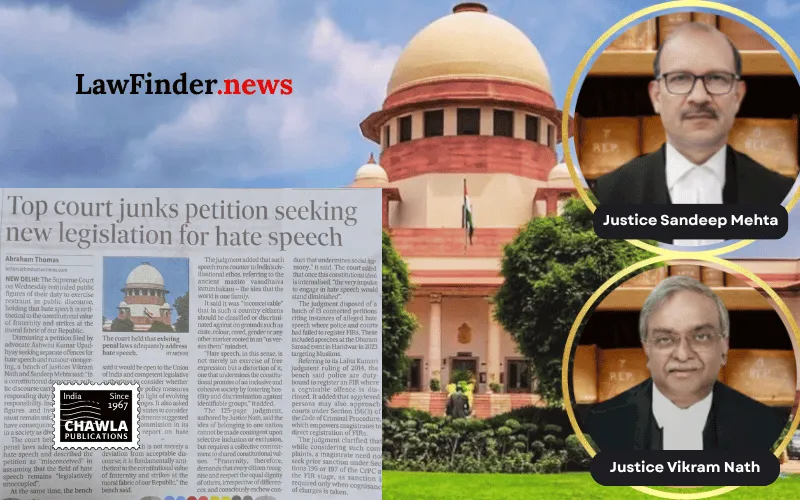
Supreme Court Upholds Legislative Primacy in Hate Speech Laws, Declines Continuing Mandamus, Court affirms police duty to register FIRs on cognizable offences without prior sanction, emphasizes enforcement over new legislation, and reiterates constitutional value of fraternity against hate speech.
In a landmark judgment dated April 29, 2026, the Supreme Court of India decisively addressed the complex issues surrounding hate speech regulation, the role of the judiciary versus the legislature, and procedural safeguards related to First Information Reports (FIRs). The judgment emerges from a consolidated batch of writ petitions, special leave petitions, and contempt petitions, including the prominent case of Ashwini Kumar Upadhyay v. Union of India.
The Court clarified that the creation or expansion of criminal offences and the prescription of punishments remain the exclusive domain of the legislature, consistent with the constitutional Doctrine of Separation of Powers. The judiciary cannot legislate new offences or compel the legislature to enact particular laws but may interpret existing statutes and suggest reforms. This principle was underscored by reference to earlier precedents including Vishaka v. State of Rajasthan and subsequent cases where judicial directions served as interim stop-gap measures only in the presence of legislative vacuum.
Regarding substantive criminal law on hate speech, the Court found no legislative void. Existing provisions within the Indian Penal Code (IPC)-and now the Bharatiya Nyaya Sanhita, 2023-adequately address offences promoting enmity, hatred, and public disorder. Key IPC sections cited include 153A, 153B, 295A, 298, and 505, which criminalize acts prejudicial to public tranquility and religious harmony. The Law Commission of India’s 267th Report (2017) was acknowledged as a comprehensive study recommending enhancements, but the Court emphasized that enforcement shortcomings, not absence of law, underlie grievances.
On the procedural front, the Court reaffirmed the binding precedent established in Lalita Kumari v. Government of Uttar Pradesh, holding that police must mandatorily register FIRs upon disclosure of cognizable offences under Section 154 of the Code of Criminal Procedure (CrPC), now replaced by the Bharatiya Nagarik Suraksha Sanhita, 2023. The Court reiterated that no police discretion exists to refuse FIR registration. Where police fail or refuse to register FIRs, aggrieved persons have statutory remedies including approaching the Superintendent of Police under Section 154(3), the Magistrate under Section 156(3), or filing complaints under Section 200 of the CrPC/BNSS.
Importantly, the Supreme Court corrected a High Court ruling that had held prior sanction was required before a Magistrate could direct FIR registration under Section 156(3) CrPC for offences involving public servants. The apex court held that the requirement of prior sanction under Sections 196 and 197 CrPC applies only at the stage of taking cognizance by the Court, not at the pre-cognizance stage of FIR registration or investigation. Consequently, Magistrates have the power to direct FIR registration and investigation without prior sanction.
The Court declined to issue a continuing mandamus for ongoing judicial supervision of executive actions relating to hate speech, noting that such judicial micromanagement is neither feasible nor consistent with constitutional principles. Instead, the Court emphasized reliance on existing statutory and constitutional remedies, cautioning against anticipatory judicial intervention absent demonstrated systemic failure.
A noteworthy part of the judgment elaborates on the constitutional value of fraternity as enshrined in the Preamble of the Indian Constitution. The Court held that hate speech fundamentally undermines fraternity, which is essential for securing dignity and unity in a pluralistic society. It invoked the ancient Indian maxim "vasudhaiva kutumbakam" (the world is one family) to underscore the ethos of inclusivity and mutual respect. The Court called upon citizens, public figures, and authorities alike to uphold constitutional harmony and restrain expressions that foment hatred or division.
While dismissing the writ petitions for lack of a legislative vacuum, the Court left open the possibility for Parliament and State Legislatures to consider further legislative or policy measures to strengthen hate speech regulation, in light of evolving societal challenges and Law Commission recommendations.
Finally, contempt petitions alleging non-compliance with earlier Supreme Court directions on suo motu FIR registrations were partly closed where compliance was established. For certain pending petitions, respondents were granted time to file responses, and High Courts were directed to consider issuing practice directions to ensure effective implementation of the declared law.
This judgment reaffirms the constitutional balance between legislature and judiciary, underscores procedural safeguards for criminal justice, and reiterates the collective responsibility to uphold the constitutional values of fraternity and dignity in combating hate speech.
Bottom Line:
Supreme Court affirms that the creation or expansion of criminal offences, including those related to hate speech, lies exclusively within the legislative domain; the judiciary cannot legislate or compel legislation but can ensure enforcement of existing laws and suggest reforms.
Statutory provision(s): Constitution of India Articles 32, 226, 19(1)(a), 51A; Indian Penal Code Sections 153A, 153B, 295A, 298, 505; Code of Criminal Procedure Sections 154, 156(3), 190, 196, 197; Bharatiya Nyaya Sanhita, 2023; Bharatiya Nagarik Suraksha Sanhita, 2023
Ashwini Kumar Upadhyay v. Union of India, (SC) : Law Finder Doc id # 2890778