Court cautions against misuse of Section 498A IPC, emphasizes need for preliminary inquiry in matrimonial cases.
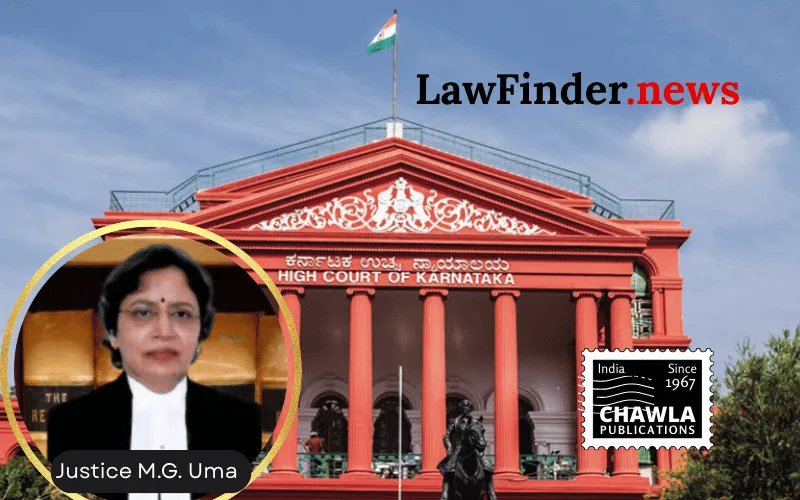
In a significant ruling, the Karnataka High Court, presided by Justice M.G. Uma, has quashed criminal proceedings against Sri Manjunath M P and others, accused of offenses under Section 498A of the Indian Penal Code (IPC) and the Dowry Prohibition Act, 1961. The court emphasized the necessity for courts and law enforcement agencies to exercise caution and scrutiny in matrimonial disputes involving general and sweeping allegations to prevent the abuse of the legal process.
The petitioners, accused in Crime No.128/2020 of Sathanur Police Station, were facing charges of dowry demands and harassment under Sections 498A, 406, 504, 506, read with Section 149 of IPC, along with Sections 3 and 4 of the Dowry Prohibition Act. The allegations were made by the second respondent, who married the first petitioner on March 1, 2020, and filed the complaint on September 16, 2020. The complaint alleged harassment and dowry demands between March 15, 2020, and June 18, 2020.
The court noted that the complaint was filed after several legal actions, including a divorce notice and police complaints filed by the first petitioner against the respondent, highlighting inconsistencies and lack of prima-facie evidence. Justice Uma stated, "The registration of criminal complaints in matrimonial disputes without preliminary inquiry and proper satisfaction by police officers is discouraged."
The judgment cited the Supreme Court’s decision in Arnesh Kumar v. State of Bihar, emphasizing the need for a preliminary inquiry and the requirement for police to ensure prima-facie satisfaction about allegations before registering an FIR. The court underscored that arrests should not be routine or mechanical, thereby safeguarding personal liberty.
Further scrutiny revealed that the financial condition of the complainant's family was inconsistent with claims of exorbitant dowry payments, leading the court to question the veracity of the allegations. The court also referenced several Supreme Court judgments, including those in Achin Gupta v. State of Haryana and Dara Lakshmi Narayana v. State of Telangana, which caution against the misuse of legal provisions in matrimonial disputes.
The court expressed concern over the widespread misuse of Section 498A IPC and urged law enforcement to adhere to guidelines requiring a preliminary inquiry before arresting individuals based on matrimonial complaints. The judgment is seen as a reaffirmation of the need to balance the protection of married women with preventing the misuse of legal provisions designed to protect them.
Bottom Line:
Misuse of Section 498A IPC and Dowry Prohibition Act - Courts must exercise caution and scrutiny in matrimonial disputes involving general and sweeping allegations to prevent abuse of process of law.
Statutory provision(s): Indian Penal Code, 1860 Sections 498A, 406, 504, 506, 149; Dowry Prohibition Act, 1961 Sections 3, 4; Criminal Procedure Code, 1973 Section 482.
Sri Manjunath M P v. State of Karnataka, (Karnataka) : Law Finder Doc id # 2853830