The court emphasized the necessity of proving animus to desert and held that mere separation is insufficient for divorce under Section 13(1)(b) of the Hindu Marriage Act, 1955.
In a significant judgment, the Karnataka High Court dismissed an appeal filed by Sri. Harish C.M., upholding the trial court's decision to deny divorce on the grounds of desertion. The appellant had sought dissolution of marriage from Smt. Lavanya Harish C.M., citing desertion under Section 13(1)(b) of the Hindu Marriage Act, 1955.
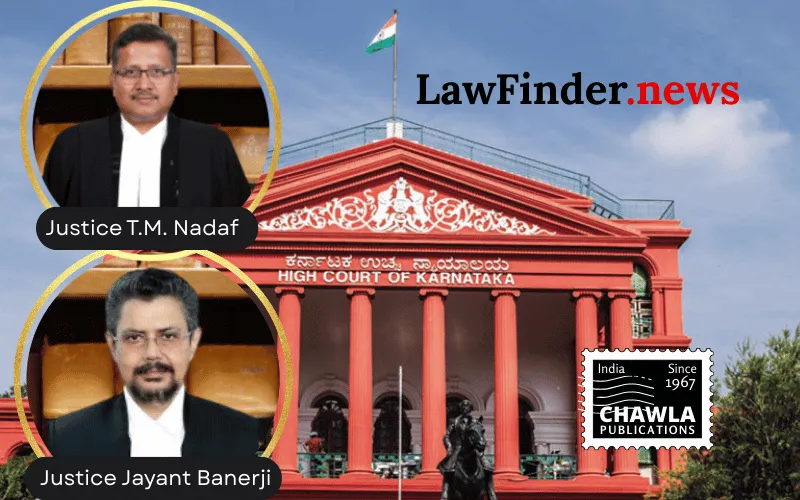
The court, comprising Justices Jayant Banerji and T.M. Nadaf, reaffirmed that desertion requires more than mere physical separation; it necessitates an intention to forsake the marital relationship permanently, known as animus deserendi. The court observed that the appellant failed to substantiate claims of desertion with adequate evidence, despite the respondent being placed ex-parte.
The case's background reveals that the couple married in December 2011 and began experiencing marital discord by 2015. The appellant accused the respondent of maintaining an extra-marital relationship, which allegedly prompted her to leave the matrimonial home. Subsequently, the respondent filed a criminal case against the appellant under Section 498A of the Indian Penal Code and the Dowry Prohibition Act, which ended in acquittal.
The trial court had previously dismissed the divorce petition, noting the lack of evidence to prove desertion or an extra-marital relationship. The High Court echoed this decision, stating that mere accusations without proof amount to mental cruelty and do not justify desertion. The court highlighted the importance of proving animus to desert, emphasizing that the burden of proof lies with the petitioner, who must establish his case with substantial evidence.
The court also addressed the appellant's argument regarding the irretrievable breakdown of marriage, noting that the trial court had correctly observed no substantial proof of such breakdown was provided. Additionally, the court dismissed the notion that the respondent's failure to contest the case could justify granting a divorce.
In conclusion, the Karnataka High Court found no merit in the appeal, thereby maintaining the trial court's ruling. The judgment underscores the legal requirement for concrete evidence in divorce proceedings based on desertion, reinforcing the principle that separation alone does not constitute grounds for divorce without the intent to permanently abandon the marriage.
The court also acknowledged the assistance of Smt. Archana K.M., appointed as Amicus Curiae for the respondent, and directed the Karnataka State Legal Services to remunerate her for her contributions to the case.
Bottom Line:
Hindu Marriage Act, 1955 - Section 13(1)(b) - Divorce on the ground of desertion - Mere living separately for a considerable period of time does not constitute desertion unless accompanied by animus to desert - Burden of proof lies on the petitioner to substantiate claims with cogent evidence.
Statutory provision(s): Hindu Marriage Act, 1955 - Section 13(1)(b); Indian Penal Code, 1860 - Section 498A; Dowry Prohibition Act, 1961 - Sections 3, 4.
Sri. Harish C.M. v. Smt, Lavanya Harish C.M., (Karnataka)(DB) : Law Finder Doc id # 2854363