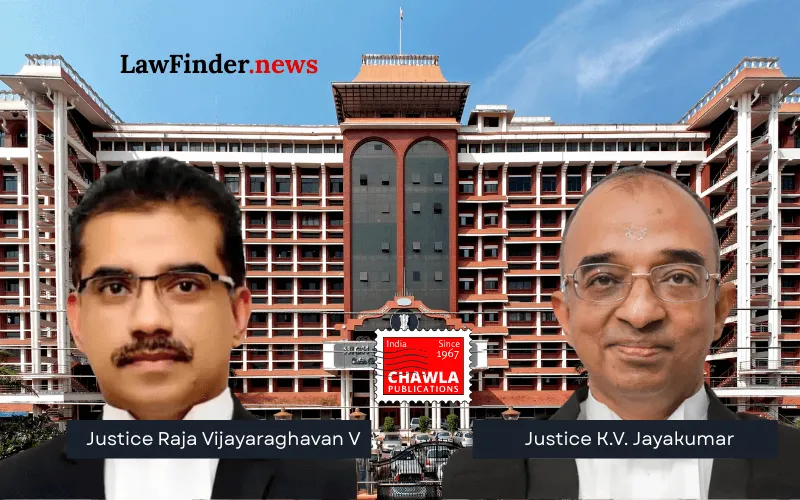
Petitioners Directed to Seek Relief in Civil Courts; Land Conservancy Act Inapplicable to Private Temples
In a significant ruling, the Kerala High Court dismissed a series of writ petitions seeking the eviction of alleged encroachers from private temple properties. The petitions, filed under Article 226 of the Indian Constitution, were dismissed by a division bench comprising Justices Raja Vijayaraghavan V. and K. V. Jayakumar. The court directed the petitioners to seek relief through competent civil courts, citing non-maintainability of the petitions due to non-joinder of necessary parties and the inapplicability of the Land Conservancy Act, 1957, to private temple lands.
The petitioners had alleged that properties belonging to various temples were encroached upon, and sought the intervention of the court to direct revenue officials to evict the encroachers. However, the court observed that the writ petitions were filed without impleading the necessary parties, such as the trustees or Ooralans of the temples, making the petitions procedurally defective.
The court also emphasized that the provisions of the Land Conservancy Act, 1957, are applicable only to lands belonging to the Devaswom Boards and not to private temple lands. This distinction rendered the petitions unsustainable under the said Act. Additionally, the court clarified that the guidelines issued by the Supreme Court in the Mrinalini Padhi case, which pertained to the management of public religious institutions, did not apply to private temples not under Devaswom Board control.
The judgment has significant implications for the management and protection of private temple properties in Kerala, underscoring the necessity for civil litigation in resolving disputes over such lands. The court's decision to redirect the petitioners to civil courts highlights the limitations of writ jurisdiction in matters involving complex property rights and the requirement for a thorough judicial process to address such issues.
The ruling reaffirmed the court's stance on the principles of natural justice, maintaining that proceedings without necessary parties are ineffective and violate these principles. The decision has been received as a critical reminder of the procedural rigor required in property-related litigations involving religious institutions.
Bottom line:-
Writ Petitions seeking eviction of encroachers from private temple properties dismissed; Petitioners directed to approach competent civil courts for relief.
Statutory provision(s): Article 226 of the Constitution of India, Land Conservancy Act, 1957
Raveendra Panicker v. District Collector Collectorate, (Kerala)(DB) : Law Finder Doc id # 2898813