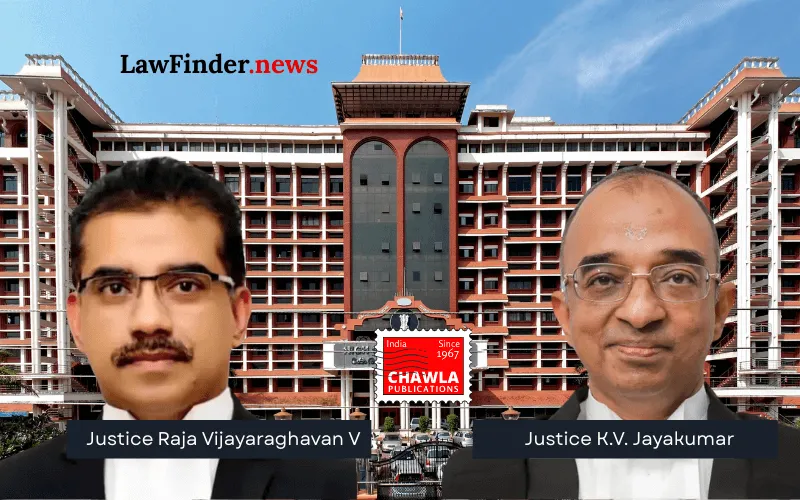
After prolonged custody and in light of bail granted to co-accused, Kerala High Court releases three appellants with stringent conditions to ensure trial participation.
The Kerala High Court has granted bail to three appellants, Rajan C.G @ Rajan Chittitappally @ Rafi and others, who were undertrial prisoners in a high-profile case involving charges under multiple statutes, including the Indian Penal Code (IPC), the Arms Act, the Unlawful Activities (Prevention) Act (UA(P) Act), and the Kerala Forest Act. The bench, comprising Mr. Gopinath P. and P.M. Manoj, JJ., delivered the judgment on April 21, 2026, allowing the appeal against the continued detention of the appellants, who have been in custody for a significant duration.
The appellants, identified as accused nos. 3, 11, and 15, were part of a group facing serious charges including conspiracy and unlawful activities related to arms training in Nilambur's deep forest area. The court's decision took into account the prolonged custody of the appellants and the precedent set by granting bail to co-accused, as evidenced in Annexures A1 to A3.
The Deputy Solicitor General of India, representing the Union of India, opposed the bail application on grounds of the severity of the charges and the risk of the appellants absconding. It was highlighted that the trial was underway, with 94 out of 287 witnesses examined, and an expected conclusion by June 2026.
Despite these arguments, the High Court emphasized the principle of parity and the need to avoid unnecessary pre-trial detention. Consequently, the court imposed strict conditions to ensure the appellants' presence during the trial, including residency restrictions, regular reporting to the National Investigation Agency (NIA), and strict communication protocols.
- The conditions outlined by the court include:
- 1. The appellants must reside in the Ernakulam Revenue District until the trial concludes.
- 2. They must furnish their place of residence to the NIA.
- 3. Weekly reporting to the NIA on designated days is mandatory.
- 4. A single mobile number must be used and communicated to the NIA, remaining active throughout the bail period.
- 5. Any attempt to tamper with evidence or influence witnesses will result in bail cancellation.
- 6. Engaging in similar activities or committing new offenses during bail will lead to legal repercussions.
The court clarified that any breach of these conditions would allow the prosecution to seek bail cancellation from the Special Court, which would assess such applications independently.
This judgment underscores the judiciary's balancing act between safeguarding individual liberty and ensuring the integrity of the judicial process in cases involving national security concerns.
Bottom Line:
Bail granted to accused after considering prolonged custody as undertrial prisoners and parity with co-accused who were granted bail earlier, subject to strict conditions to ensure presence during trial.
Statutory provision(s): Section 439 of the Criminal Procedure Code, 1973, Sections 120B, 121, 121A, 122 of the IPC, Section 27 (1) (e) (iv) of the Kerala Forest Act 1961, Sections 7 r/w 27(2) of the Arms Act, Sections 18, 18 A, 20, 38, and 39 of the UA(P) Act, 1967.