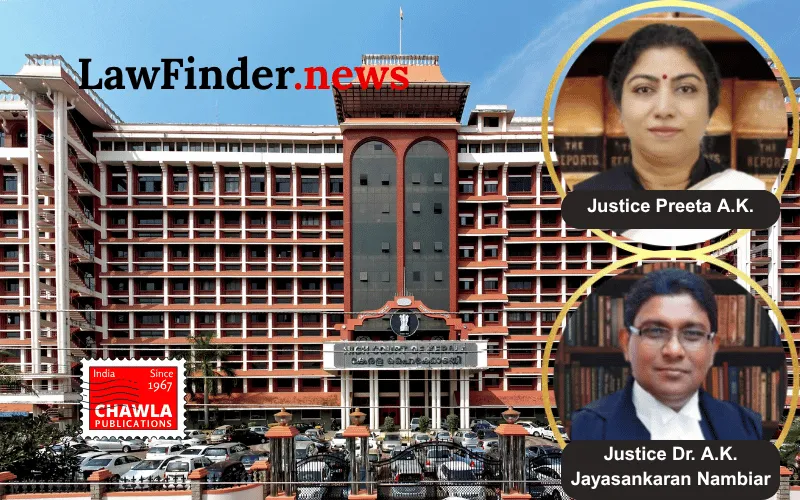
Court affirms that private disputes between tenants over parking rights are not amenable to writ jurisdiction under Article 226
In a recent judgment, the Kerala High Court dismissed a writ appeal filed by Rajesh Babu, a tenant in Kottarakkara Municipality, against the State of Kerala and others. The Division Bench, comprising Dr. A.K. Jayasankaran Nambiar and Preeta A.K., upheld the decision of a learned Single Judge who had earlier dismissed the writ petition on grounds that it involved a private dispute not suitable for writ jurisdiction under Article 226 of the Constitution of India.
The case revolved around a parking dispute between Rajesh Babu, who runs an electronic showroom, and another tenant, the seventh respondent, who is an architect and structural engineer. Babu contended that the architect was parking his vehicle in a manner that obstructed access to his showroom, seeking a declaration of such parking as illegal and also requesting police protection to prevent the obstruction.
The learned Single Judge, however, noted that both parties were tenants of the same landlady and shared equal rights to the parking space as per their contractual agreements. Consequently, the judge ruled that the issue was a private matter to be resolved through civil courts rather than through writ jurisdiction, which is primarily intended for public law issues.
In the appeal, the counsel for Babu argued that the learned Single Judge failed to consider the statutory provisions under Section 117 of the Motor Vehicles Act, 1988, which pertain to the regulation of parking in public spaces. The appellant also cited a previous judgment, Noushad M. v. State of Kerala, in support of his case.
The Division Bench, after examining the contentions and precedents, concluded that the premises in question were not public spaces but private property accessed by the public in the ordinary course of business. Thus, the provisions of the Motor Vehicles Act and the responsibilities of statutory authorities to regulate public spaces were not applicable. The court emphasized that a writ of mandamus is a public law remedy, not typically available for private wrongs unless they involve a public duty or law and order situation.
The court agreed with the learned Single Judge's view that the grievance over parking did not constitute a public law issue warranting writ jurisdiction. As a result, the writ appeal was dismissed, reaffirming the lower court's decision. The judgment underscores the principle that private disputes, especially those concerning contractual rights between tenants, are best resolved through civil litigation rather than seeking public law remedies.
Bottom line:-
A writ of mandamus or remedy under Article 226 of the Constitution of India is pre-eminently a public law remedy and is not generally available to address private wrongs, especially in cases where the grievance pertains to private rights and does not involve a law and order situation or public duty.
Statutory provision(s): Article 226 of the Constitution of India, Section 117 of the Motor Vehicles Act, 1988
Rajesh Babu v. State of Kerala, (Kerala)(DB) : Law Finder Doc id # 2905729