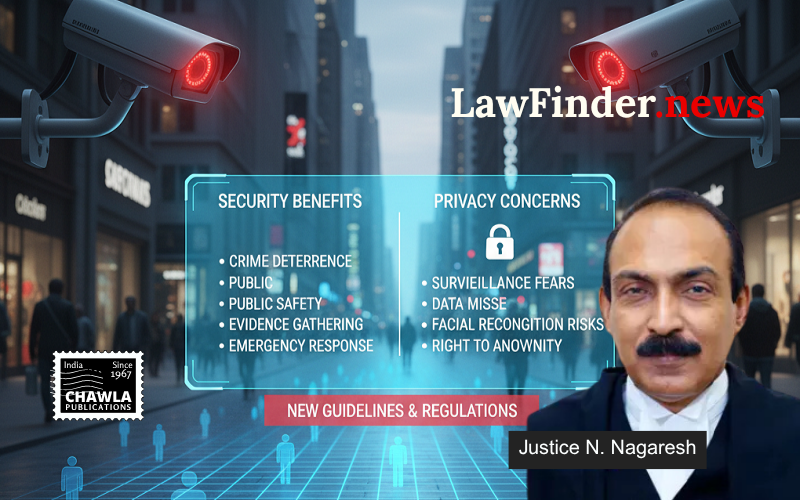
Court Balances Right to Privacy with Right to Security in Landmark Decision
In a significant ruling, the Kerala High Court has dismissed a petition challenging the installation of CCTV cameras by neighbours, underscoring the delicate balance between the right to privacy and the right to security. The case, Sivasankaran @ Sankarankutty v. State of Kerala, was adjudicated by Justice N. Nagaresh, who emphasized the constitutional need to balance individual privacy rights with the security needs of others.
The petitioners, Sivasankaran and his wife, argued that their neighbours, respondents 5 to 7, had installed CCTV cameras in a manner that intruded into their private spaces, including their drawing, dining, and bedroom areas. This, they contended, was a violation of their right to privacy under Article 21 of the Indian Constitution.
However, the respondents justified the installation citing security concerns. The 5th respondent, an 80-year-old woman and a victim of grave criminal offences, including criminal intimidation and attempted rape, reportedly faced ongoing threats from the petitioners. The CCTV cameras, according to the respondents, were crucial for her safety and peace of mind.
The court noted the landmark judgment in K.S. Puttaswamy (Retired) v. Union of India, which established the right to privacy as a fundamental right but also emphasized the test of proportionality when privacy rights conflict with other rights, such as the right to security. Justice Nagaresh pointed out that while privacy is intrinsic to human dignity and autonomy, it must be weighed against the security needs of others, especially in cases involving potential harm or threats.
In his judgment, Justice Nagaresh stated, "Right to privacy of one and the right to security, which is an element of right to life of another, are to be balanced delicately when they are in conflict with each other." He further clarified that without any concrete evidence of snooping, the court cannot mandate the removal of security measures like CCTV cameras.
The decision aligns with previous case law, including the Agnes Michael v. Cheranellore Grama Panchayat judgment, which cautioned against using surveillance technology to invade personal privacy but upheld its use for legitimate security purposes.
Ultimately, the court dismissed the petition, highlighting the necessity of CCTV cameras for the respondents' security and the lack of proven privacy violations. This ruling serves as a critical reminder of the judicial responsibility to balance competing rights, ensuring both privacy and security are respected within legal and constitutional frameworks.
Bottom Line:
Right to Privacy under Article 21 and Right to Life under Article 21 are to be balanced delicately when in conflict with each other.
Statutory provision(s): Article 21 of the Constitution of India, Sections 354, 354A(1), 354B, 511, 376 of the Indian Penal Code.
Sivasankaran @ Sankarankutty v. State of Kerala, (Kerala) : Law Finder Doc Id # 2808657