Court affirms secular nature of Shanti appointments, endorses Kerala Devaswom Recruitment Board’s authority to accredit Thanthra Vidyalayas, dismisses claims of religious and constitutional violations
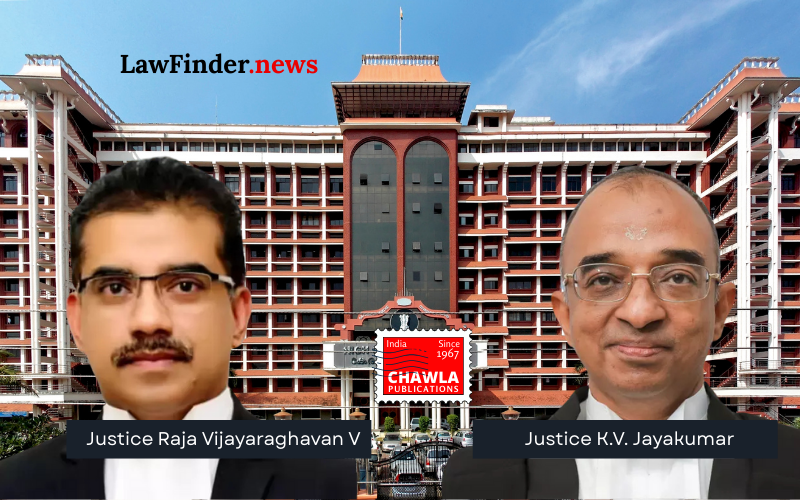
In a significant judgment delivered on October 22, 2025, a Division Bench of the Kerala High Court, comprising Justices Raja Vijayaraghavan V and K. V. Jayakumar, dismissed a writ petition filed by the Akhila Kerala Thanthri Samajam and others challenging the Travancore Devaswom Board Officers’ and Servants’ Service Rules, 2022. The petitioners had contested Qualification No. 2(ii) of Rule 6(1)(b), which requires candidates for the post of Part-time Shanthi (temple priest) to possess certificates from Thanthra Vidyalayas or reputed institutions accredited by the Travancore Devaswom Board (TDB) or the Kerala Devaswom Recruitment Board (KDRB).
The petitioners, representing approximately 300 traditional Thanthri families, contended that the KDRB lacked statutory authority and expertise to recognize or approve Thanthra Vidyalayas and that the new qualification norms undermined the sanctity and authenticity of traditional Thanthric education. They alleged that the rules arbitrarily excluded candidates trained under traditional Thanthris and promoted a secularized recruitment process that violated their religious rights under Articles 25 and 26 of the Constitution of India.
The court carefully examined the submissions and the statutory framework, including the Travancore-Cochin Hindu Religious Institutions Act, 1950, and the Kerala Devaswom Recruitment Board Act, 2015. It observed that the appointments to the post of Shanthi are essentially secular acts governed by the Devaswom Board and the Recruitment Board under delegated legislative powers. The court noted that the KDRB is empowered by law to prescribe qualifications, conduct examinations, and accredit institutions for recruitment purposes.
The judgment emphasized that while temple rituals and worship are religious acts protected under the Constitution, the appointment process for priests is a secular administrative function. The court relied on precedents such as Seshammal v. State of Tamil Nadu (1972) and N. Adithayan v. Travancore Devaswom Board (2002), which upheld the validity of State regulation over secular aspects of temple administration and rejected claims that hereditary or caste-based priesthood constitutes an essential religious practice.
Furthermore, the court rejected the petitioners’ claim that their society constituted a religious denomination entitled to protection under Article 26. It held that the petitioners’ organization is a caste-based society without distinct religious tenets and thus not eligible for constitutional denomination rights.
The court also upheld the validity of the Travancore Devaswom Board Officers’ and Servants’ Service Rules, 2022, and the KDRB’s accreditation process, which involved expert committees, syllabus standardization, and periodic inspections to ensure quality and uniformity in Thanthric education. It observed that the rules promote inclusivity, transparency, and merit-based recruitment, aligning with constitutional mandates of equality and social justice.
The judgment dismissed the writ petition, affirming the authority of the TDB and KDRB to regulate Shanti recruitment and recognizing the secular nature of the appointment process while respecting the religious context of temple worship.
Statutory provision(s): Travancore-Cochin Hindu Religious Institutions Act, 1950 (Sections 29(5), 35(2)(e)), Kerala Devaswom Recruitment Board Act, 2015 (Sections 9, 18), Travancore Devaswom Board Officers' and Servants' Service Rules, 2022 (Rule 6(1)(b))
This ruling clarifies the balance between religious freedom and State regulation in temple administration, confirming that the appointment of priests is subject to secular oversight to ensure fairness, inclusivity, and standardized qualifications in Kerala’s temple boards.
Akhila Kerala Thanthri Samajam v. State of Kerala, (Kerala)(DB) : Law Finder Doc Id # 2796860