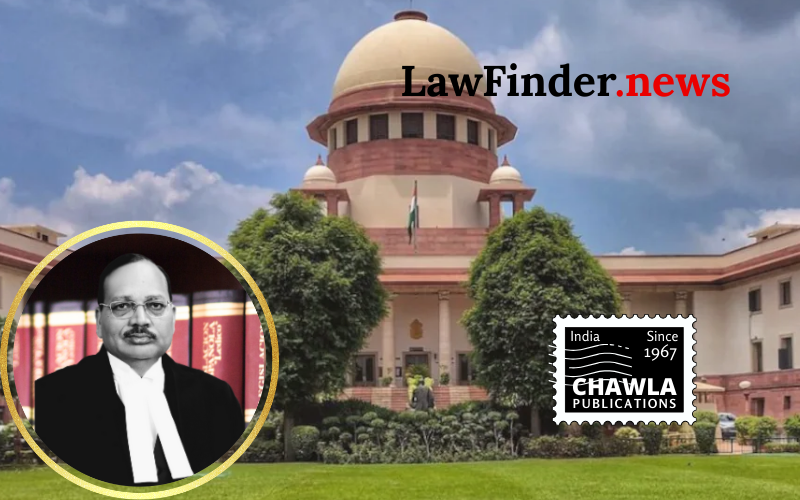
New Delhi/Sonipat, Nov 29 The Kesavananda Bharati case was not a mere legal precedent; it stood out as one of the most profound affirmations of India's commitment to constitutionalism and the rule of law, Chief Justice of India Surya Kant said on Saturday.
The historic Kesavananda Bharati verdict of 1973, which laid down the "basic structure doctrine" of the Constitution, clipped Parliament's widest power to amend the Constitution and simultaneously gave the judiciary the authority to review any amendment on grounds of its violation.
Speaking at the opening ceremony of an international convention on 'The Independence of Judiciary: Comparative Perspective on Rights, Institutions and Citizens' at the OP Jindal Global University here, CJI Kant said the true brilliance of the Kesavananda majority lay in recognising that what could not be amended was what made the Constitution meaningful – “its just soul, painstakingly designed by our framers under the visionary guidance of Dr B R Ambedkar”.
The verdict produced the ‘basic structure doctrine’, which was neither a flight of judicial fancy nor an indulgence in philosophical abstraction, the CJI asserted.
“I do not regard the Kesavananda Bharati case as a mere legal precedent. It stands, instead, as one of the most profound affirmations of India's commitment to constitutionalism and the rule of law.
“It was, in truth, an act of constitutional archaeology: the judges unearthed, from within the four corners of the Constitution, those foundational principles that had always lain embedded in its design, waiting to be revealed by interpretation rather than invention,” CJI Kant said.
Justice Surya Kant, who took oath as the 53rd CJI on November 24, said the truly "basic" doctrine continues to remind us that our Constitution is not a transient political document; it is a covenant between the state and the citizen.
"As the battery of lawyers told the Bench about 50 years ago, it limits power not to weaken it, but to civilise it. This is also precisely why every generation that revisits Kesavananda Bharati rediscovers that the Constitution's strength does not lie in ink or parchment, but in the probity of those who interpret and defend it.
“Its survival has always depended on a community of custodians who read it not as a frozen command, but as a living charge," he said.
CJI Kant also said the basic doctrine has allowed our Constitution to grow without losing its centre – to stretch toward new realities, and yet remain tethered to its founding spirit.
“As this momentous conference reminds us: the basic structure doctrine is not to be a relic of the past, but a map for charting our future. It is the conscience that keeps our democracy from drifting into absolutism, as we modernise our institutions and confront new frontiers,” the CJI said.
The occasion also saw the inauguration of the world's largest ‘moot court’, ‘Nyayabhyasa Mandapam', alongside the International Mooting Academy for Advocacy, Negotiation, Dispute Adjudication, Arbitration and Resolution (IMAANDAAR).
Later, there was an enactment of the Kesavananda Bharati case and its impact on India’s constitutional history, highlighting the legacy of the landmark case and its role in ensuring judicial independence.
It included R Venkataramani, Attorney General of India; Tushar Mehta, Solicitor General of India; and senior advocates Abhishek Singhvi and Sidharth Luthra.
Through the Kesavananda Bharati verdict, delivered on April 24, 1973, the apex court propounded the ‘basic structure doctrine’ of the Constitution, which holds that certain fundamental features of it, such as democracy, secularism, federalism, and the rule of law, cannot be amended by Parliament.
CJI Kant said India was barely 23 years into its constitutional life when the verdict was delivered in 1973.
“With the nation still defining its institutions, still learning to walk the tightrope between idealism and power, the question before the court at that time was nothing less than civilisational, namely, could a parliamentary majority, however large, rewrite the moral DNA of the Constitution?" CJI Kant said.
“Our judiciary was barely two decades old, young enough, one might think, to falter under pressure. And yet, it did not. With the courage that far surpassed its age, the Supreme Court chose the path of both constitutional maturity and morality. It refused to bend the Constitution into the shape of convenience.
“That, to me, remains the true miracle of Kesavananda Bharati: not only did it produce the basic structure doctrine, but it also proved that a young republic could, by the strength of its consensus, rise to the moral stature of a much older one.
“That decision revealed something intrinsic about India's democratic temperament. It showed that our constitutional culture is not brittle. It bends without breaking, it adapts, but it never abandons its moral compass,” he said.
Drawing an analogy to a charpoy to describe this balance, he said the frame of a charpoy is strong, its legs are sturdy, but it is the careful weaving of rope that gives it form and function.
“Pull the ropes too tight, and it snaps under strain. Leave them too loose, and the whole structure sags. It is the precision of that weave – the deliberate tension between rigidity and flexibility - that makes it enduring," he said.
"The basic structure doctrine is the weave of our constitutional ‘charpoy’. The text provides the frame, the institutions form the legs, but the rope - that interlacing of restraint, balance, and moral discipline – is what makes the entire structure useful, just and lasting," the CJI noted.
Earlier, Union Law Minister Arjun Ram Meghwal said during his address that the government is working tirelessly to modernise the legal infrastructure.
“We are moving towards a system that is fully future-ready through initiatives like the e-courts project and AI-driven tools, which will help overcome language barriers. Our civilisation carries a deep commitment to justice embedded in our constitutional framework,” Meghwal said.