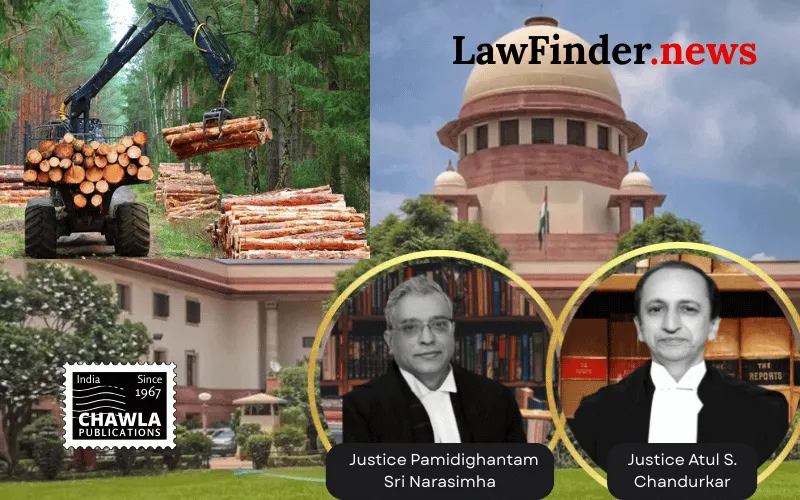
Supreme Court Clarifies Land Exchange with Forests: Not Private Property Sub Landmark Judgment Reiterates Compliance with Forest Definition and Legal Norms
In a significant ruling delivered by the Supreme Court of India, the legal status of land exchanged with forest land has been clarified, underscoring the strict adherence to forest laws and the definition of "forest" as laid down in prior judgments. The case, titled State of Uttar Pradesh v. Jyoti Bhushan Mishra, was adjudicated by Justices Pamidighantam Sri Narasimha and Atul S. Chandurkar on December 10, 2025.
The dispute originated in the Sahelwa Wildlife Sanctuary, Balrampur District, Uttar Pradesh, where local farmers had exchanged their agricultural land with forest land in 1965 due to crop damage caused by wild animals. The exchanged land, which merged with the existing forest habitat, was under the uninterrupted possession of the Forest Department for over two decades, yet it remained unnotified as a reserve forest under the Indian Forest Act, 1927.
The controversy arose when respondents in the case, who had purchased the land from some farmers despite knowing its exchange history, sought permission to cut and remove fallen trees. The High Court of Allahabad initially allowed the removal of trees, questioning the land's status as forest property.
However, the Supreme Court intervened, emphasizing that the exchanged land cannot be treated as private property and reiterated the necessity of compliance with the definition of "forest" as established in T.N. Godavarman Thirumulkpad v. Union of India (1997) 2 SCC 267. The Court highlighted that actions related to cutting or moving trees must adhere to applicable laws, rules, and regulations.
The judgment further pointed out the omission by the High Court in considering relevant notifications and documents that determine the legal status of the land. The Supreme Court clarified that any direction regarding tree removal must respect the legal obligations under forest laws and regulations.
This ruling reinforces the procedural rigor required in handling lands associated with forest habitats and signifies the judiciary's commitment to upholding environmental laws. The Court’s decision underscores the importance of following legal procedures when dealing with land categorized under forest definitions, ensuring that such lands are not misclassified or misused.
As the appeal concluded, the Supreme Court disposed of the case with the directive that applications for tree-cutting permissions must be processed as per law, ensuring compliance with established definitions and legal frameworks.
Bottom Line:
Land exchanged with forest land cannot be treated as private property when it has merged with the forest habitat and is under uninterrupted possession of the Forest Department for over 20 years. Any direction regarding cutting or moving trees requires compliance with the definition of "forest" as laid down by the Supreme Court and adherence to applicable laws.
Statutory provision(s): Indian Forest Act, 1927, T.N. Godavarman Thirumulkpad v. Union of India (1997) 2 SCC 267
State of Uttar Pradesh v. Jyoti Bhushan Mishra, (SC) : Law Finder Doc Id # 2824287