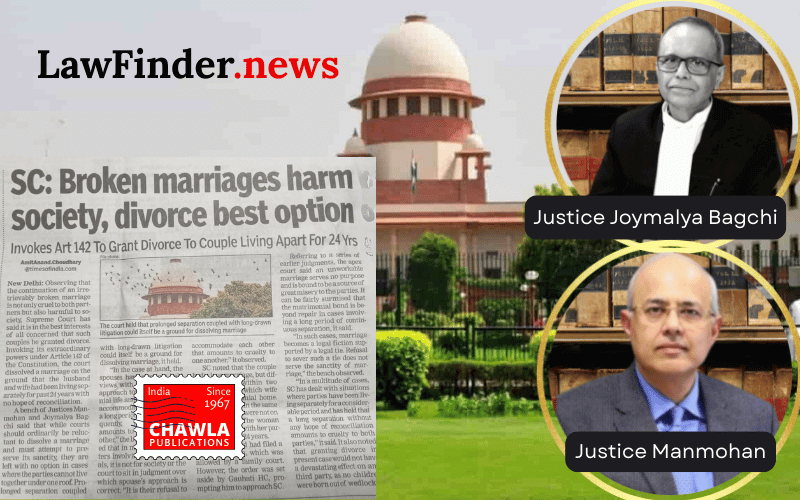
Supreme Court Dissolves 24-Year Estranged Marriage Under Article 142 Supreme Court exercises Article 142 to dissolve a marriage due to irretrievable breakdown after 24 years of separation, emphasizing the cruelty of prolonged separation.
In a landmark decision, the Supreme Court of India has dissolved the marriage between Nayan Bhowmick and Aparna Chakraborty, citing irretrievable breakdown after a prolonged separation of 24 years. The judgment, delivered by Justices Manmohan and Joymalya Bagchi, emphasized that the long period of separation without any hope for reconciliation amounted to cruelty for both parties.
The case, originating from a judgment by the Gauhati High Court (Shillong Bench), involved an appeal by Nayan Bhowmick challenging the High Court's decision, which had set aside a decree of divorce granted by the Additional Deputy Commissioner (Judicial), Shillong. The couple, who had been married since 2000, had been living separately since 2001 without any children from the wedlock.
The Supreme Court noted that despite repeated efforts for reconciliation, including a mediation attempt ordered by the court in 2012, there was no hope for reconciliation. The court highlighted that the strongly held views and refusal to accommodate each other by the spouses amounted to mutual cruelty, as the marriage had become unworkable and a source of misery.
The decision also underscored the Supreme Court's power under Article 142 of the Constitution to dissolve marriages on the grounds of irretrievable breakdown, beyond the fault and blame doctrine. Citing previous judgments, the court emphasized that public interest lies in recognizing the reality of irreparable breakdowns to prevent prolonged suffering and litigation.
The court concluded that the dissolution of the marriage would not adversely affect any third party, as there were no children involved. It upheld the decree of divorce granted by the Additional Deputy Commissioner (Judicial), Shillong, and set aside the impugned order of the High Court.
Bottom Line:
Irretrievable breakdown of marriage coupled with long period of separation and absence of reconciliation efforts are valid grounds for dissolution of marriage under Article 142 of the Constitution of India.
Statutory provision(s): Article 142 of the Constitution of India, Section 13(1)(i-a) of the Hindu Marriage Act, 1955
Nayan Bhowmick v. Aparna Chakraborty, (SC) : Law Finder Doc Id # 2822108