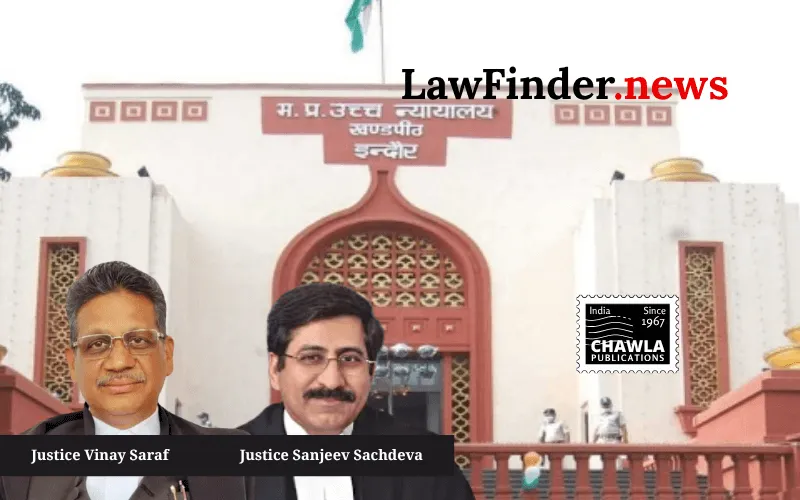
State Circular Excluding General Category Students from Discrimination Complaints Deemed Unconstitutional
In a significant judgment, the Madhya Pradesh High Court has directed the Students Grievances Redressal Committee to entertain complaints of discrimination from all categories of students, including those from the general category. This decision comes in response to a petition filed by Amber Sharma challenging a circular issued by the State Government, which excluded general category students from lodging discrimination complaints before the committee.
The bench comprising Chief Justice Sanjeev Sachdeva and Justice Vinay Saraf heard the arguments presented by the petitioner’s counsel, Shri Harshwardhan Sharma. The petitioner contended that the exclusion of general category students was discriminatory and violated Articles 14 and 15 of the Constitution of India. These articles guarantee equality before the law and prohibit discrimination on grounds such as caste, religion, race, sex, or place of birth.
The petitioner also highlighted that a similar issue is pending before the Supreme Court in the case of Mritunjay Tiwari v. Union of India, which challenged the University Grants Commission (Promotion of Equity in Higher Education Institutions) Regulations, 2026. The Supreme Court had stayed the operation of these regulations due to ambiguities and potential misuse, specifically related to the definition of caste-based discrimination which was exclusive to Scheduled Castes, Scheduled Tribes, and Other Backward Classes.
In light of the Supreme Court’s interim order, the petitioner argued that the state circular mirrored the same discriminatory stance by excluding general category students. The High Court, acknowledging the merit in these arguments, granted interim relief and directed the inclusion of general category students in the discrimination redressal mechanism.
The judgment emphasized that the exclusion based on caste was inherently discriminatory and contrary to the principles enshrined in the Constitution. The court reiterated that all students, irrespective of their caste or category, should have equal access to justice and the right to raise complaints of discrimination.
The State Government has been given four weeks to file a reply to the petition, with a rejoinder to be submitted within two weeks thereafter. The case is scheduled to be listed after six weeks for further proceedings.
This ruling marks a progressive step towards ensuring equality and fairness in addressing grievances related to discrimination in educational institutions. It reinforces the constitutional mandate that prohibits discrimination and promotes inclusivity, allowing students from all backgrounds to seek redressal for grievances without bias or exclusion.
Bottom line:-
Students Grievances Redressal Committee cannot exclude general category students from raising complaints of discrimination.
Statutory provision(s):
Articles 14, 15, and 21 of the Constitution of India, University Grants Commission (Promotion of Equity in Higher Education Institutions) Regulations, 2026.
Amber Sharma v. Union of India, (Madhya Pradesh)(DB)(Indore) : Law Finder Doc id # 2891870