Court Cites Judicial Overload as Reason for Delay; Case Transferred for Timely Resolution
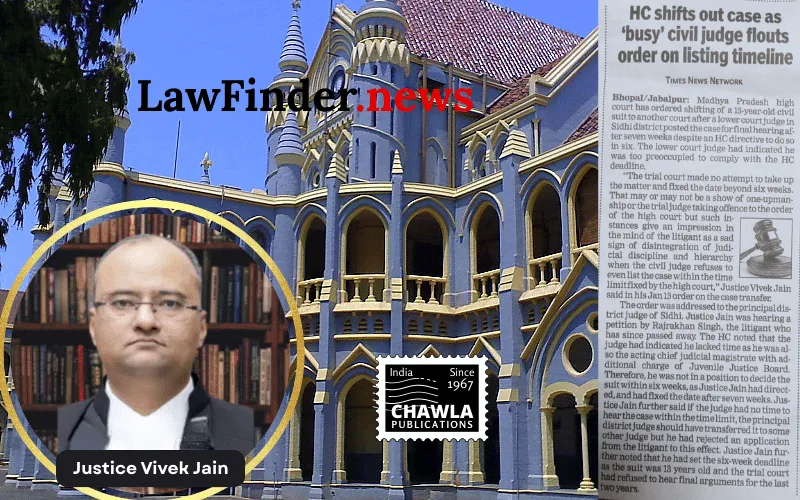
In a significant move to address prolonged delays in civil litigation, the Madhya Pradesh High Court has ordered the transfer of a 13-year-old civil suit, underscoring the importance of judicial efficiency and timely justice. The case, which has been pending final arguments for over two years, was transferred from the Third Civil Judge, Senior Division, Sidhi, to another court with the requisite judicial time to expedite the proceedings.
The judgment, delivered by Justice Vivek Jain on January 13, 2026, comes in response to a petition challenging the Principal District Judge's earlier decision to reject an application for transferring the case. The petitioners, led by Rajrakhan Singh, argued that the trial court's inability to conduct final arguments was due to an overwhelming workload, preventing compliance with the High Court's directive to conclude the case within six weeks.
The High Court noted that the trial court had consistently postponed hearings since November 2023, despite repeated scheduling for final arguments. The trial court's presiding officer, who also holds responsibilities as the Chief Judicial Magistrate and with the Juvenile Justice Board, cited workload constraints as the reason for not adhering to the High Court's timeline. This persistent delay in processing the case was highlighted as a concern, with the High Court expressing disappointment over the lack of judicial discipline.
Justice Jain's ruling emphasized the necessity of transferring the case to ensure that the pending final arguments are heard and a judgment is rendered without further delay. The High Court instructed the Principal District Judge, Sidhi, to relocate the suit to a court where sufficient judicial time is available, thus facilitating the resolution of this long-standing litigation.
The decision reflects the judiciary's commitment to addressing systemic issues that contribute to case backlogs and ensuring that justice is not only served but served timely. The High Court's intervention underscores the broader objective of maintaining judicial efficiency and upholding the litigants' right to a fair and expedient trial.
Bottom Line:
Application under Section 24 of CPC for transfer of a 13-year-old suit was allowed on the ground that the Presiding Officer was unable to hear final arguments and pass judgment within the time limit set by the High Court, due to workload and lack of judicial time.
Statutory provision(s): Civil Procedure Code, 1908 Section 24