The Court declares the exclusion of married daughters from ex-gratia and leave encashment benefits unconstitutional, ensuring equality in service benefits distribution.
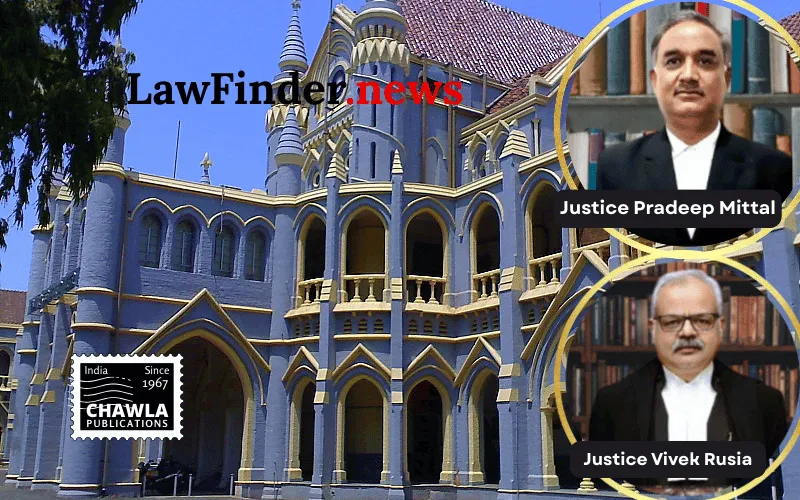
In a landmark decision, the Madhya Pradesh High Court, presided over by Justices Vivek Rusia and Pradeep Mittal, has ruled that married daughters are entitled to claim ex-gratia and leave encashment as legal heirs of deceased employees. The Court found the denial of such benefits based solely on marital status to be unconstitutional and discriminatory.
The case, titled Prasanna Namdev (Soni) v. High Court of Madhya Pradesh, revolved around the petitioner, Prasanna Namdev, whose father, Late Prabhat Kumar Namdev, was employed as a driver at the District Court, Narsinghpur. After his demise, Prasanna, who was nominated as the legal heir following her mother's passing, was denied ex-gratia and leave encashment on the grounds of being a married daughter. The respondents had sanctioned other benefits like the General Provident Fund (GPF) and insurance amounts, but withheld these specific benefits.
The petitioner challenged this decision, asserting that it violated Articles 14 and 300A of the Indian Constitution. The Court agreed, citing that the exclusion of married daughters lacked any rational basis and amounted to hostile discrimination. The judges emphasized that rights to retiral dues and leave encashment are statutory and constitutional rights that cannot be denied without due process.
The High Court referred to previous rulings, including the case of Meenakshi Dubey v. M.P. Poorva Kshetra Vidyut Vitran Co. Ltd., which established that excluding married daughters from service benefits is against constitutional mandates. Additionally, the Court highlighted that ex-gratia, although discretionary, serves to provide immediate relief to the deceased employee's family and should not be denied based on marital status.
In conclusion, the High Court directed the respondents to release the withheld benefits to Prasanna Namdev within 60 days, reinforcing the principle that marital status should not be a barrier to claiming rightful benefits as a legal heir.
Bottom Line:
Married daughters are entitled to claim ex-gratia and leave encashment as legal heirs of deceased employees, and denial on the ground of marital status is unconstitutional.
Statutory provision(s): Articles 14, 300A, 39(a) of the Constitution of India.