Court declares election null and void for corrupt practice under Section 123(2) of Representation of the People Act, 1951; second highest vote-getter Ramniwas Rawat declared elected.
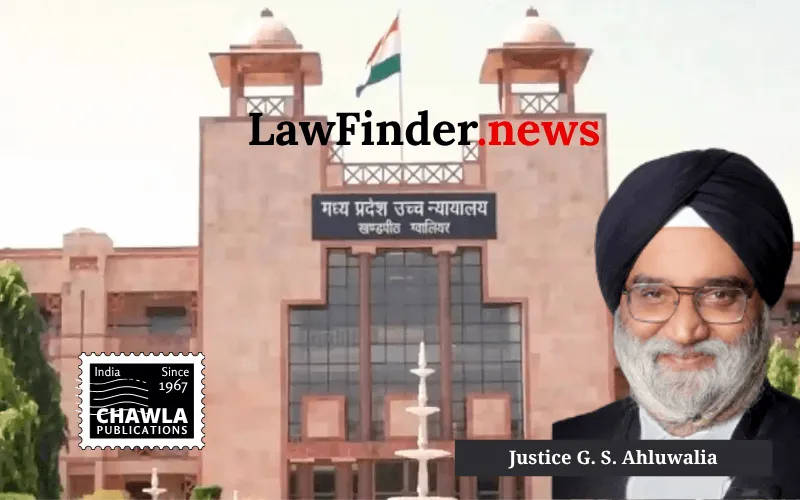
In a landmark judgment dated March 9, 2026, the Madhya Pradesh High Court (Gwalior Bench) delivered a significant verdict in Election Petition No. 24 of 2024, filed by Ramniwas Rawat challenging the election of Mukesh Malhotra from Assembly Constituency 02 Vijaypur, District Sheopur. Justice G.S. Ahluwalia presided over the case and allowed the petition, declaring the election of Mukesh Malhotra null and void on grounds of corrupt practice.
The petitioner, Ramniwas Rawat, a seasoned politician and former MLA, contested the 2024 bye-election on Bharatiya Janata Party (BJP) ticket after resigning from Congress. Mukesh Malhotra, the respondent, contested on Congress ticket and was declared winner with 50.66% votes, narrowly defeating Rawat who secured 46.95%.
The crux of the petition was that Mukesh Malhotra deliberately suppressed material information about his criminal antecedents in the affidavit filed under Form 26, as mandated by Section 33A of the Representation of the People Act, 1951. Out of six criminal cases registered against Malhotra, he disclosed only two cases partially and omitted four others entirely, including convictions and framing of charges.
Key facts established during trial include:
- Two criminal cases (Crime No. 2/2022 and Crime No. 93/2023) were disclosed but without accurate details. Malhotra falsely declared that no charges had been framed in these cases, although charges were framed on December 14, 2022, and October 17, 2023, respectively.
- Four other cases, including a conviction for illegal cutting of 210 trees in a reserved forest area (Forest Crime No. 32773/2014), were not disclosed at all. Though the conviction entailed fine and default imprisonment of one month, Malhotra failed to inform voters despite the Assembly Constituency's Adivasi population revering trees as sacred.
- Malhotra was a law graduate and postgraduate in Social Science, undermining his defense of "bonafide mistake" or lack of legal awareness.
- Publication of criminal antecedents by Malhotra and his party was limited to newspapers with minimal circulation in the constituency, allegedly to keep the electorate uninformed.
The High Court drew upon an extensive array of Supreme Court precedents, including Union of India v. Association for Democratic Reforms, Krishnamoorthy v. Sivakumar, Poonam v. Dule Singh, and others emphasizing the fundamental right of the electorate to know the criminal antecedents of candidates to make an informed choice. The Court held that the deliberate suppression and false declaration regarding framing of charges amounted to corrupt practice under Section 123(2) of the Representation of the People Act, 1951. The act interfered with the free exercise of electoral rights by voters and was sufficient ground to invalidate the election.
Significantly, the Court clarified that it is not necessary to prove that such suppression materially affected the election result as the presumptive effect of undue influence suffices. The Court also rejected Malhotra’s claim that non-disclosure of cases with convictions less than one year imprisonment or acquittals did not warrant disclosure, holding that disclosure of all material criminal antecedents is necessary for transparency and purity of elections.
Consequently, the election of Mukesh Malhotra was declared null and void, and Ramniwas Rawat, who secured the second highest votes, was declared elected as MLA from Vijaypur. The Election Commission and Returning Officer were directed to complete all formalities accordingly.
This judgment reinforces the Supreme Court’s consistent jurisprudence that candidates must fully and honestly disclose their criminal records and that suppression constitutes corrupt practice inviting annulment of election results. It sends a strong message to political parties and candidates about adherence to transparency norms to uphold democratic values.
Bottom Line:
Election law - Candidate's deliberate and knowing suppression of material information regarding criminal antecedents, including framing of charges, amounts to corrupt practice under Section 123(2) of the Representation of the People Act, 1951 - Election result declared null and void - Second highest vote recipient declared elected.
Statutory provision(s): Representation of the People Act, 1951 Sections 33A, 80, 81, 86, 100(1)(b), 123(2), 125-A; Conduct of Elections Rules, 1961 Rule 94-A; Indian Forest Act Sections 26(1)(a)(g), 66(i); Indian Penal Code Sections 294, 323, 332, 505(2), 506, 186, 252, 34.
Ramniwas Rawat v. Mukesh Malhotra, (Madhya Pradesh)(Gwalior) : Law Finder Doc id # 2863695