Court Criticizes Prosecution's Conduct and Highlights Importance of Dying Declarations
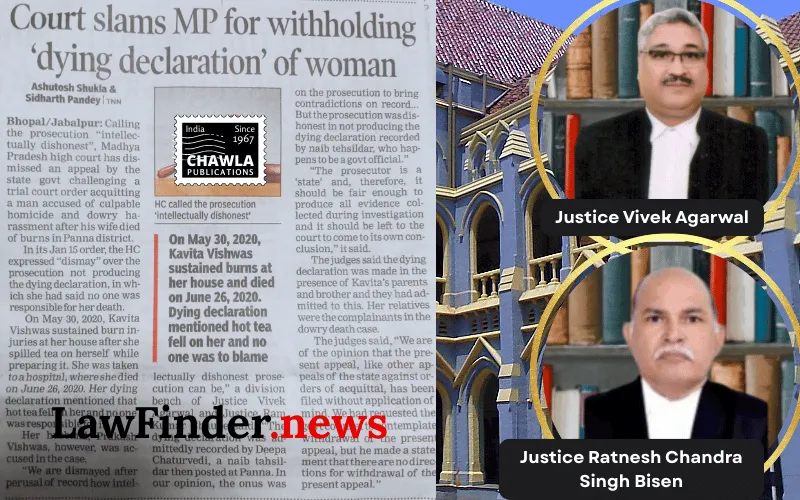
In a significant ruling, the Madhya Pradesh High Court has upheld the acquittal of Prakash Vishwas and others in a dowry death case, emphasizing the critical role of a dying declaration in criminal proceedings. The Division Bench, comprising Justices Vivek Agarwal and Ratnesh Chandra Singh Bisen, dismissed the State's appeal against the judgment of the Sessions Court, which had acquitted the accused of charges under Sections 304B, 498A read with Section 34 of the Indian Penal Code, and Section 4 of the Dowry Prohibition Act, 1961.
The case revolved around the death of Kavita Vishwas, who succumbed to burn injuries after allegedly catching fire accidentally while preparing tea. Her dying declaration, recorded by Naib Tahsildar Deepa Chaturvedi, stated that the incident was accidental, and she had no complaints against anyone. This declaration was pivotal in the court's decision to uphold the acquittal.
The High Court criticized the prosecution for its "intellectual dishonesty" in not presenting all evidence, including the dying declaration, during the trial. The court emphasized the duty of the prosecution to present all collected evidence transparently to assist the court in reaching the truth.
The judgment reiterated principles established by the Supreme Court regarding dying declarations, asserting that such a declaration could be the sole basis for acquittal if it inspires full confidence in the court. The court found the dying declaration in this case to be credible, as it was given in a fit state of mind, free from influence, and corroborated by medical evidence.
The court also addressed the procedural aspect, noting the absence of any complaints or objections from the deceased's family regarding the dying declaration. Despite their presence at the hospital, they did not raise concerns about potential threats or coercion affecting the declaration.
In dismissing the appeal, the court expressed dismay at the prosecution's practice of filing appeals against acquittals without due contemplation and advised reconsideration of such actions to uphold judicial efficiency and fairness.
Bottom Line:
Dying declaration, if found to be given in a fit state of mind and free from influence, can form the sole basis for acquittal. Prosecution must present all evidence collected during investigation, and failure to do so reflects poorly on the fairness of the prosecution.
Statutory provision(s): Indian Penal Code, 1860 Sections 304B, 498A, 34; Dowry Prohibition Act, 1961 Section 4; Criminal Procedure Code, 1973 Section 378.
State of Madhya Pradesh v. Prakash, (Madhya Pradesh)(DB)(Jabalpur) : Law Finder Doc id # 2845195