Judicial review limited; court dismisses PIL against age criteria and registration closure in women empowerment scheme
In a significant ruling, the Madhya Pradesh High Court, Indore Bench, dismissed a public interest litigation (PIL) challenging the State Government's policy decision regarding the Mukhyamantri Ladli Behna Yojana, 2023. The scheme, aimed at empowering women by improving health, nutrition, and promoting economic independence, had come under scrutiny for its age criteria and the cessation of new registrations.
The PIL, filed by Paras Saklecha, questioned the legality of the State's decision to stop fresh registrations under the scheme from August 20, 2023, and sought amendments to the age criteria, arguing that the policy was arbitrary and discriminatory. The petitioner contended that the exclusion of women below 21 years and above 60 years from availing the benefits violated Article 14 of the Constitution of India, which guarantees equality before the law.
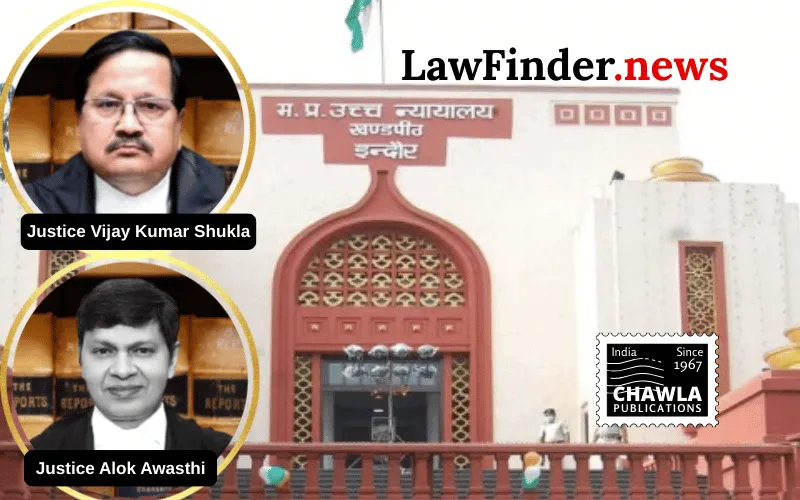
The High Court Bench, comprising Justices Vijay Kumar Shukla and Alok Awasthi, emphasized the limited scope of judicial review in matters of policy decisions. Citing precedents, the court reiterated that such decisions are primarily within the domain of the State Government and interference is warranted only if the policy is unconstitutional, arbitrary, or discriminatory.
In its judgment, the court referenced several landmark rulings, including Balco Employees Union v. Union of India, which underscored the judiciary's role in examining the legality, not the wisdom, of economic and policy decisions. The court further highlighted that the setting of age criteria and the timeline for scheme implementation are prerogatives of the State and do not constitute grounds for judicial intervention unless proven to be manifestly arbitrary or discriminatory.
Despite the petitioner's arguments, the court found no merit in the claims of arbitrariness regarding the age criteria or the cessation of registrations. It held that these decisions fall within the administrative discretion of the State Government, aimed at effective policy implementation.
The court also dismissed the petitioner's plea for enhancing the financial benefits under the scheme, noting that such matters cannot be addressed through a PIL, particularly when the petitioner is not a direct beneficiary or aspirant under the scheme.
The judgment reaffirms the judiciary's stance on respecting the separation of powers, allowing the executive to formulate and execute policy decisions unless they infringe on constitutional rights. The dismissal of the petition upholds the State's authority to determine the operational parameters of its empowerment schemes and sets a precedent for similar cases involving public welfare policies.
Bottom Line:
Judicial review of policy decisions is limited and interference by courts is permissible only if the policy is unconstitutional, arbitrary, discriminatory, malafide, or contrary to statutory provisions.
Statutory provision(s): Article 226 of the Constitution of India