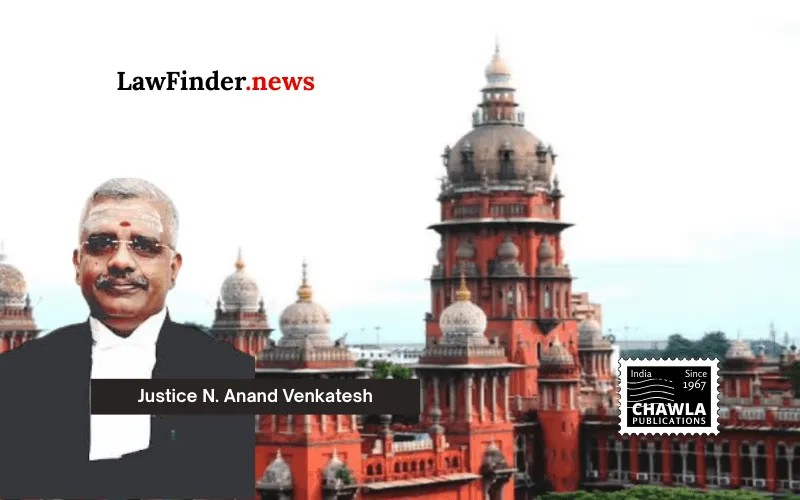
Court mandates fair hearing and demonstration opportunity for rejected solar power invention patent
In a significant ruling from the Madras High Court, Justice N. Anand Venkatesh directed the Controller of Patents to allow Kannan Gopalakrishnan, the petitioner, a fair hearing and opportunity to demonstrate his invention, ‘Solar Supplemental Power Source’, which had previously been rejected. The court emphasized the necessity of providing inventors with adequate opportunity to present their innovations before a final rejection decision is made.
Kannan Gopalakrishnan filed the writ petition after his patent application, initially rejected in November 2024, was again dismissed in a review application in June 2025. The petitioner claimed that the review application was rejected without granting him a hearing, which he argued is against the principles of natural justice.
The application, filed on August 5, 2020, was initially dismissed on the grounds that it did not satisfy Section 3(a) of the Patents Act, 1970, which pertains to inventions that are frivolous or contrary to well-established natural laws. The patent involved a device designed to generate electricity even in the absence of sunlight, utilizing a wheel structure and electro-mechanical devices.
In the review application, Gopalakrishnan sought to demonstrate a prototype of the invention, providing links to video clips showcasing its implementation. However, the patent office rejected the review application, prompting the legal challenge.
Justice Venkatesh highlighted that patent rights are invaluable and must not be dismissed without providing applicants a fair chance to present their case. While the court found no apparent error in the rejection order itself, it exercised discretion under Article 226 of the Constitution of India to ensure fairness. The court underscored the importance of equity and the need to prevent the waste of potentially useful inventions.
The court ordered the Controller of Patents to permit the petitioner to demonstrate the prototype within four weeks, following which a reasoned decision should be made within four months. This decision aims to balance legal procedure with equitable considerations, acknowledging the effort and innovation involved in patent applications.
The ruling sets a precedent in ensuring that patent applicants are granted sufficient opportunities to sustain their inventions, reinforcing the judiciary's role in safeguarding inventors' rights against procedural inadequacies.
Bottom Line:
Patent application rejection must not occur without providing sufficient opportunity of fair hearing to the applicant. Courts may exercise discretion under Article 226 of the Constitution of India to ensure that an invention is given a fair chance to sustain.
Statutory provision(s): Patents Act, 1970 Section 3(a), Patents Act, 1970 Section 77(1)(f), Section 77(1)(g), Patents Rules, 2003 Rules 130(1), 130(2), Order 47, Rule 1 CPC, Constitution of India, 1950 Article 226.