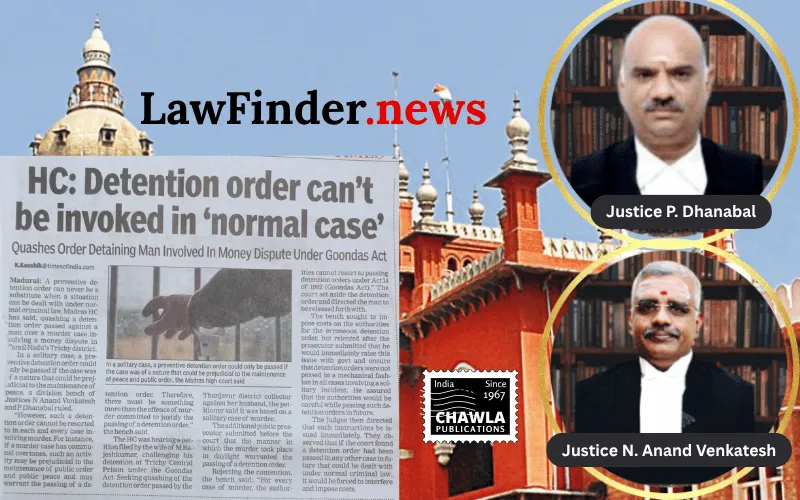
Court rules detention under Tamil Nadu Act 14 of 1982 inappropriate for single incident, emphasizes reliance on normal criminal law.
In a significant judgment, the Madras High Court's Madurai Bench has set aside a detention order issued against Rajeshkumar, who had been detained under the Tamil Nadu Act 14 of 1982 for a solitary murder incident. The court criticized the authorities for mechanically applying detention laws in cases that could be adequately addressed under normal criminal law.
The court, comprising Justices N. Anand Venkatesh and P. Dhanabal, heard the habeas corpus petition filed by the detenu's wife, R. Vembu. The detention order, issued in October 2025, labeled Rajeshkumar as a "Goonda" under Section 2(f) of the Tamil Nadu Act 14 of 1982, following his involvement in a murder case arising from a financial dispute.
The petitioner contended that the detention was based on a single incident, and the authorities improperly considered an unrelated bail order as grounds for detention. The court agreed, noting the non-application of mind by the Detaining Authority, which relied on an irrelevant bail order from a dissimilar case.
The Additional Public Prosecutor argued that despite being a solitary case, the manner of the murder in broad daylight justified detention to maintain public order. However, the court emphasized that a solitary incident of murder, particularly one involving a personal dispute, did not inherently disrupt public peace and could be handled through regular legal channels.
Highlighting the absence of any criminal cases against Rajeshkumar between 2020 and 2025, the court found no justification for branding him as a habitual offender. The court underscored that detention orders should not serve as a substitute for standard criminal proceedings, cautioning authorities against the indiscriminate use of detention laws in isolated incidents.
The judges further admonished the Detaining Authority for assuming the likelihood of bail based on a previous, unrelated case, thus demonstrating a lack of due diligence. The court declared that such oversight invalidated the detention order.
In conclusion, the court allowed the habeas corpus petition, ordering the immediate release of Rajeshkumar unless further detention was required in another case. The ruling serves as a reminder to law enforcement to apply detention laws judiciously and not as a routine response to singular criminal acts.
Bottom Line:
Detention order under Tamil Nadu Act 14 of 1982 cannot be mechanically passed in cases involving solitary incidents of murder which could be dealt with under normal criminal law. Non-application of mind by Detaining Authority in considering irrelevant bail order as a ground for detention vitiates the detention order.
Statutory provision(s): Tamil Nadu Act 14 of 1982, Section 2(f), Indian Penal Code Sections 147, 148, 294(b), 307, 302, Arms Act Section 25(1)(A)
R.Vembu v. State of Tamil Nadu, (Madras)(DB)(Madurai Bench) : Law Finder Doc id # 2869995