Court highlights violation of Tamil Nadu Hindu Religious and Charitable Endowments Act, 1959, directs restoration of temple heritage, and calls for constitution of new Board of Trustees
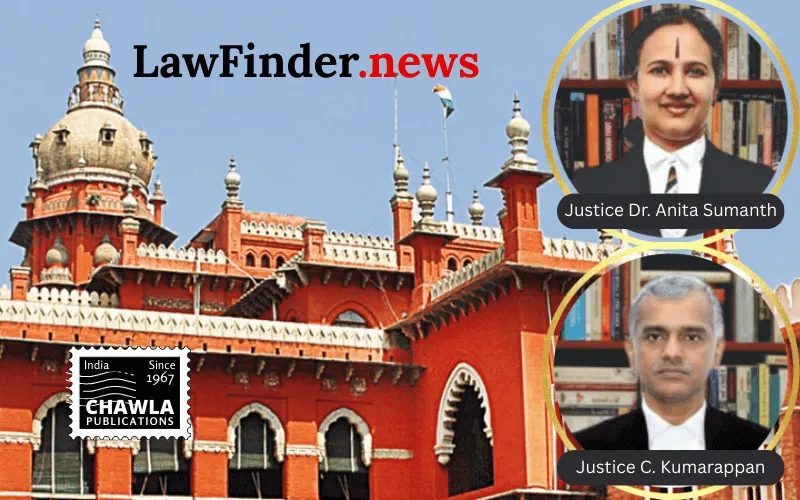
In a significant judgment dated January 23, 2026, the Madurai Bench of the Madras High Court quashed the Government Order (G.O. Ms. No. 135 dated 08.03.2024) and related administrative proceedings sanctioning Rs. 40 crore for the ‘Iconic Project’ - a development initiative for the Arulmigu Kallazhagar Temple in Madurai district. The writ petitions filed by A.V.B. Prabhu and others challenged the legality of the State’s unilateral decision to allocate and spend substantial temple funds on extensive civil works and infrastructure upgrades without proper trustees’ approval or adherence to statutory norms.
The Court’s detailed ruling found that the State’s action amounted to a usurpation of the management rights vested in the temple’s Board of Trustees under the Tamil Nadu Hindu Religious and Charitable Endowments Act, 1959 (“HR & CE Act”). The Court emphasized that any major developmental projects or expenditure proposals must originate from the Trustees, who are the rightful managers of the temple’s funds and affairs. Contrary to the statutory scheme, the temple had been managed for over a decade by a “Fit Person” and an Executive Officer appointed by the government, without a constitutionally mandated Board of Trustees in place until 2023.
The Court scrutinized the financial management of the temple, observing irregularities such as depletion of accumulated surpluses from over Rs. 107 crores in 2023 to Rs. 62 crores in 2024 without proper budgeting or sanction. The expenditure under the ‘Iconic Project’ was not reflected in the annual budgets submitted to the Commissioner, violating Sections 35, 36, and 86 of the HR & CE Act and related Rules governing fund utilization and audit. The Court held that the State’s announcements and resolutions to allocate temple funds for infrastructure upgrades were legally unsanctioned and arbitrary.
Regarding the role of the Executive Officer, appointed since 1966, the Court reiterated the Supreme Court’s precedent in Dr. Subramanian Swamy v. State of Tamil Nadu (2014) that such appointments are temporary and meant only to address crises or maladministration. The continued presence of the Executive Officer long after the necessity had ceased was found unjustified. The Court directed immediate constitution of a new Board of Trustees to ensure the temple’s administration aligns with statutory provisions and constitutional rights.
Further, the Court highlighted concerns over unauthorized constructions, especially those infringing upon Archaeological Survey of India (ASI) protected monuments and the inappropriate siting of facilities such as staff quarters and sewage treatment plants adjacent to sacred temple water bodies. It ordered removal or modification of such structures and restoration of the temple’s original heritage layout based on the 1938 Sthalapurana and maps. The Court instructed all compliance within three months and mandated submission of status reports.
The judgment underscores the fiduciary responsibility of the State, Trustees, and devotees to safeguard temple properties and funds, affirming the Court’s parens patriae jurisdiction over religious institutions. It calls for transparency, adherence to financial discipline, and respect for the temple’s religious and architectural ethos in development activities.
Bottom Line:
State's unilateral deployment of substantial temple funds for large-scale construction without proper trustee involvement and statutory compliance is illegal; Executive Officer's indefinite tenure unjustified post-2015 rules; Court exercises parens patriae jurisdiction to safeguard temple interests.
Statutory provision(s):
Tamil Nadu Hindu Religious and Charitable Endowments Act, 1959 – Sections 23, 35, 36, 46, 47, 54, 66, 86, 87, 90, 92, 93, 116;
Management and Preservation of Properties of Religious Institutions Rules, 1964;
Constitution of India – Articles 25 and 26;