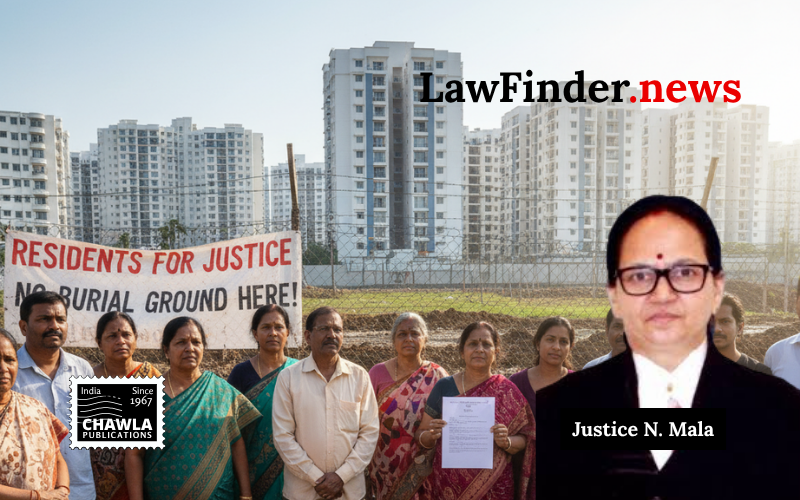
Court Orders Exhumation of Bodies Buried in Violation of Zoning and Statutory Norms
In a significant ruling, the Madras High Court has quashed the license granted for a burial ground adjacent to a residential development project, thereby upholding zoning regulations and statutory compliance. The judgment, delivered by Justice N. Mala, revolved around the interpretation of zoning norms under the Tamil Nadu Combined Development and Building Rules, 2019, and the statutory provisions of the Tamil Nadu Urban Local Bodies Act, 1998.
The case was brought before the court by M/s. Stellar Developer, a promoter of a residential apartment complex named 'BLUE TIDE' in Madanandapuram Village, Kanchipuram District. The developer challenged the license issued to the Church of South India Trust Association for establishing a burial ground on adjacent land, citing violations of zoning regulations and statutory procedures.
The court examined the zoning norms detailed in Annexure XVIII of the Tamil Nadu Combined Development and Building Rules, 2019, which restrict non-residential activities such as burial grounds to one per sub-division. Justice N. Mala interpreted the regulation to mean "any one and not each," thereby ruling that additional burial grounds in the same sub-division contravened the legislative intent for regulated and planned development.
The court also found that the statutory provisions under Section 388 of the Tamil Nadu Urban Local Bodies Act, 1998, were violated. It noted that the license was granted without the prescribed fees and that the application process lacked transparency and procedural fairness.
In a noteworthy aspect of the judgment, the court addressed the locus standi of the petitioner, affirming that the developer, though not the owner of the land, had the standing to challenge the license due to the impact on business prospects and investment.
Justice N. Mala ordered the exhumation of bodies buried in the unauthorized burial ground, referencing legal precedents and public health considerations. The court instructed the respondents to conduct the exhumation within twelve weeks, with costs borne by the Church of South India Trust Association if carried out by authorities.
The judgment underscores the importance of adhering to zoning regulations and statutory compliance, ensuring that development and land use are consistent with planning laws. The court emphasized that any deviation from prescribed procedures undermines the rule of law and leads to arbitrary and unplanned land utilization.
Bottom Line:
Tamil Nadu Combined Development and Building Rules, 2019 - License for burial ground - Interpretation of zoning norms, statutory compliance, and locus standi of the petitioner analyzed in the context of the Tamil Nadu Urban Local Bodies Act, 1998 and Tamil Nadu Combined Development and Building Rules, 2019.
Statutory provision(s): Tamil Nadu Combined Development and Building Rules, 2019, Tamil Nadu Urban Local Bodies Act, 1998 Section 388(4), Tamil Nadu Village Panchayat (Provision of Burial and Burning Grounds) Rules, 1999.
M/s. Stellar Developer v. Commissioner, (Madras) : Law Finder Doc Id # 2803893