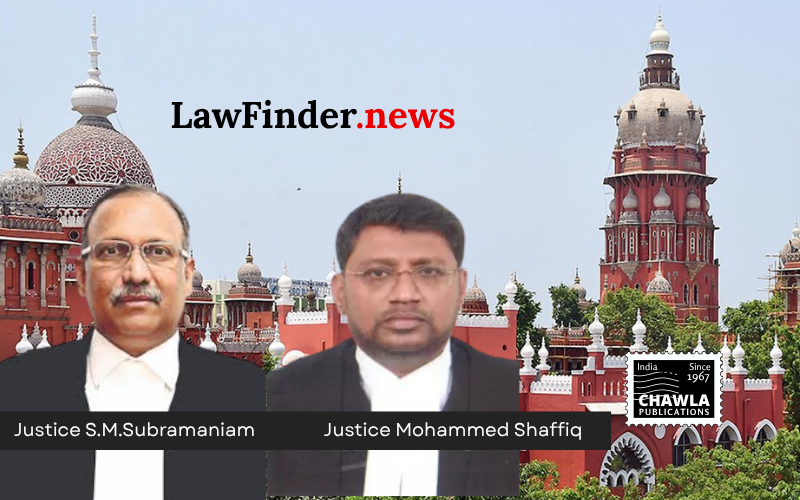
Court emphasizes principles of judicial recusal and modifies status quo order to facilitate public interest projects
In a significant ruling, the Madras High Court, comprising Justices S.M. Subramaniam and Mohammed Shaffiq, dismissed a plea for judicial recusal and lifted a status quo order impeding infrastructure projects in the case of "State of Tamil Nadu v. Madras Race Club."
The court was hearing an appeal by the State of Tamil Nadu against an interim order that maintained the status quo on a property leased to the Madras Race Club, which was challenged by the State following the termination of the lease agreement. The State contended that the status quo order was obstructing essential public works, including the development of ponds and an Eco Park, crucial for managing the monsoon season's heavy rains.
The Madras Race Club had sought the recusal of Justice S.M. Subramaniam, alleging potential bias due to his previous involvement in related cases. However, the court emphasized the principles laid down by the Supreme Court regarding judicial recusal, stating that mere allegations of bias without substantive evidence do not warrant recusal. The bench underscored that impartiality and independence are the judiciary's hallmarks, and a judge should not recuse themselves based on unfounded apprehensions.
Drawing on precedents, including the Supreme Court's Constitution Bench in the "Supreme Court Advocates on Record Association v. Union of India," the court reaffirmed that recusal requests must be based on reasonable grounds and cogent materials rather than whimsical suspicions. The judges noted that the apprehension of bias must be viewed from the perspective of a reasonable person and not through unfounded fears.
In its order, the court modified the status quo to allow the State to continue with the development and strengthening of public infrastructure projects, crucial for public welfare, especially during the monsoon season. The court cited Section 41(ha) of the Specific Relief Act, 1963, which prohibits injunctions that impede the progress of infrastructure projects, highlighting the importance of allowing such works to proceed in the public interest.
The court's decision is a reaffirmation of the judiciary's commitment to maintaining its independence and ensuring that public interest projects are not stalled due to legal proceedings. The case is set to return for further hearings in four weeks, with notices issued to all parties involved.
Bottom Line:
Request for judicial recusal based on alleged bias due to previous decisions and involvement in cases was rejected. The court clarified principles of recusal, emphasizing that mere apprehension of bias must be reasonable and supported by cogent materials, and not whimsical or baseless.
Statutory provision(s): Specific Relief Act, 1963, Section 41(ha)
State of Tamil Nadu v. Madras Race Club, (Madras)(DB) : Law Finder Doc Id # 2800057