Interim relief granted to prevent suppression of lawful speech, with a focus on preserving democratic discourse on social media.
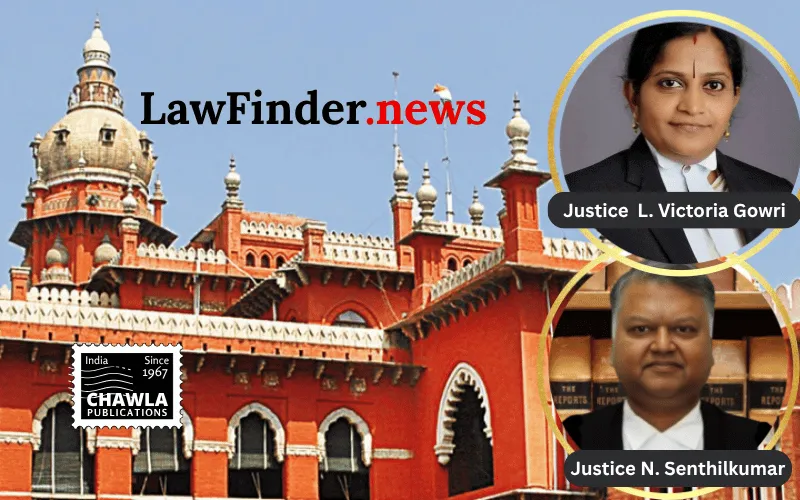
In a significant ruling underscoring the constitutional guarantee of free speech, the Madras High Court has issued an interim stay on a government notice mandating the blocking of multiple URLs on social media platform X/Twitter. The judgment was delivered by a division bench comprising Justices L. Victoria Gowri and N. Senthilkumar, in response to a writ petition filed by social activist P. Chockalingam. The court ordered the restoration of all affected URLs, emphasizing the protection of political criticism, democratic dissent, satire, and public discourse under Article 19(1)(a) of the Indian Constitution.
The case, titled P. Chockalingam v. Additional Chief Secretary to Government, questioned the legality of a notice issued by the Cyber Crime Wing, Tamil Nadu, which directed the removal/blocking of URLs without providing individualized reasons or adhering to statutory safeguards. The petitioner argued that the notice violated constitutional protections and was issued under Section 79(3)(b) of the Information Technology Act, 2000, without complying with the necessary procedural safeguards under Section 69A.
The court highlighted the importance of free speech, particularly when it involves criticism of the government and its policies, and stated that such speech is a constitutional right and not a privilege granted by the state. The judgment referenced the landmark Supreme Court decision in Shreya Singhal v. Union of India, which differentiates between discussion, advocacy, and incitement, affirming that only speech that reaches the level of incitement can be lawfully restricted.
In its analysis, the court found the government's notice to be lacking in specific reasoning, failing to demonstrate how each URL posed a threat under Article 19(2) of the Constitution. The court also criticized the short compliance timeline of three hours as disproportionate, given the absence of any disclosed emergency.
The ruling mandates the government to communicate with X Corp to restore the blocked URLs and grants the respondents the opportunity to provide a detailed counter affidavit justifying their actions. The court's decision reinforces the need for any restriction on speech to be legally justified, necessary, proportionate, and accompanied by individualized reasoning.
The matter is scheduled for further hearing on June 8, 2026, when the respondents are expected to present their case, including the statutory basis for the notice, the reasons for blocking each URL, and whether due process was followed.
Bottom line:-
The freedom of speech and expression under Article 19(1)(a) of the Constitution of India protects political criticism, democratic dissent, satire, and robust public discourse on social media. Any restriction on such speech must comply with the constitutional safeguards under Article 19(2) and demonstrate legality, necessity, proportionality, and individualised reasoning.
Statutory provision(s): Articles 14, 19(1)(a), and 19(2) of the Constitution of India, Sections 69A and 79(3)(b) of the Information Technology Act, 2000, Information Technology (Intermediary Guidelines and Digital Media Ethics Code) Rules, 2021.