Court rules payment for securing government job void, no legally enforceable debt under NI Act
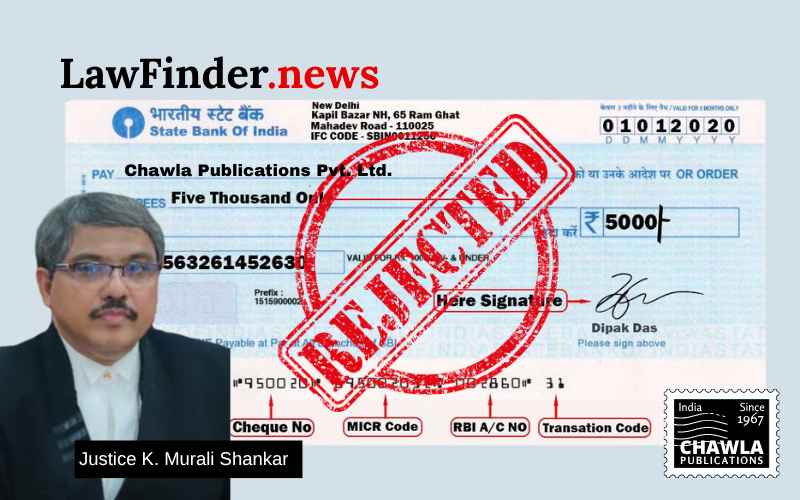
In a significant ruling, the Madurai Bench of the Madras High Court has upheld the acquittal of K. Murugan in a cheque bounce case, asserting that payments made for securing government jobs are against public policy and do not constitute a legally enforceable debt under Section 138 of the Negotiable Instruments Act, 1881. The judgment was delivered by Justice K. Murali Shankar on October 17, 2025, in the case of P. Kulanthaisamy v. K. Murugan.
The appellant, P. Kulanthaisamy, had alleged that he paid Rs. 3 lakhs to the accused, K. Murugan, purportedly to secure a conductor job in the Tamil Nadu State Transport Corporation (TNSTC). Upon failing to secure the job, Murugan issued a cheque to repay the amount, which was dishonored due to insufficient funds. Kulanthaisamy subsequently filed a complaint under Section 138 of the NI Act, which led to the trial and eventual acquittal of Murugan by the Fast Track Magistrate Court, Srivilliputtur.
The High Court, in its judgment, emphasized that the agreement between Kulanthaisamy and Murugan was void ab initio, as it involved illegal gratification for securing a government job. Relying on Section 23 of the Indian Contract Act, 1872, the court reiterated that agreements with unlawful consideration are void. The court also cited the legal maxim "in pari delicto potior est conditio possidentis," meaning when both parties are at fault in an immoral or illegal act, the court will not assist either party.
Justice Shankar, referencing previous judgments, including the Delhi High Court's decision in Virender Singh v. Laxmi Narain, underscored that neither party in such transactions can seek legal enforcement of the agreement or restitution under Section 65 of the Indian Contract Act, as the agreement is void from the beginning.
This ruling serves as a reminder that engaging in or facilitating unlawful agreements, particularly those involving public employment, will not be supported by the judiciary. The court's decision highlights the importance of adhering to legal and ethical standards in contractual agreements, especially in matters involving public service employment.
Bottom Line:
Section 138 of the Negotiable Instruments Act is not applicable if the cheque was issued to repay money given for securing a job, as such payment is opposed to public policy and does not constitute a legally enforceable debt.
Statutory provision(s): Section 138 of the Negotiable Instruments Act, 1881; Section 23, Section 65 of the Indian Contract Act, 1872
P. Kulanthaisamy v. K. Murugan, (Madras)(Madurai Bench) : Law Finder Doc Id # 2807631