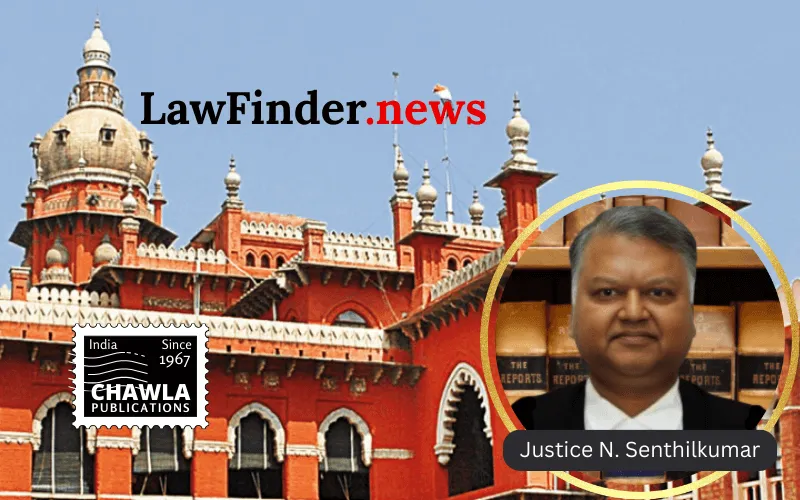
Court rules against blanket injunctions on social media content without concrete evidence of personality rights violations or commercial exploitation.
In a significant ruling, the Madras High Court, presided over by Justice N. Senthilkumar, dismissed an interim application by T. Rangaraj seeking to restrain Ms. Joy Crizildaa from allegedly defamatory activities on social media. The judgment emphasized the fundamental right to freedom of speech and expression under Article 19(1)(a) of the Indian Constitution and underscored the necessity of meeting the conditions of Article 19(2) to impose any restrictions.
The case arose when T. Rangaraj, a director of Madhampatty Thangavelu Hospitality Private Limited and a public figure, claimed that Ms. Crizildaa had disseminated false and defamatory content about him, adversely affecting his personal and professional reputation. He sought an injunction to remove the said content from social media platforms and prevent further dissemination.
Justice Senthilkumar noted the absence of prima facie evidence demonstrating a violation of Rangaraj's personality rights or commercial exploitation by Ms. Crizildaa. The court highlighted that merely identifying social media links and photographs was insufficient to substantiate claims of personality rights infringement. It further pointed out that the plaintiff failed to establish how the content in question led to commercial gains for the defendants.
The court's decision was grounded in the principle that freedom of expression is a fundamental right, and any restriction must be justifiable under Article 19(2). The judgment referenced multiple precedents, including the Supreme Court's stance on the constitutional protection of speech and expression through the internet, as laid out in Anuradha Bhasin v. Union of India.
The court also referred to the doctrine of "Strategic Litigation against Public Participation" (SLAPP), cautioning against the misuse of legal proceedings to stifle free speech and public participation. It reiterated that interim injunctions in defamation suits should only be granted in exceptional cases where there is clear evidence of malicious intent or falsehood.
In conclusion, the court dismissed Rangaraj's applications, reiterating that the plaintiff had not demonstrated a prima facie case against the defendants. The ruling serves as a reaffirmation of the judiciary's commitment to upholding freedom of speech and expression, ensuring that any restrictions are judiciously applied and backed by substantial evidence.
Bottom Line:
The court emphasized that freedom of speech and expression under Article 19(1)(a) is a fundamental right and any restriction on it must meet the conditions of Article 19(2). A blanket injunction to remove social media content without prima facie evidence of violation of personality rights or commercial exploitation is not permissible.
Statutory provision(s): Article 19(1)(a), Article 19(2), Commercial Courts Act, 2015 Section 2(1)(c)(xvii), Bharatiya Nyaya Sanhita, 2023 Sections 115(2) and 351(2).
T.Rangaraj v. Ms.Joy Crizildaa, (Madras) : Law Finder Doc Id # 2834364