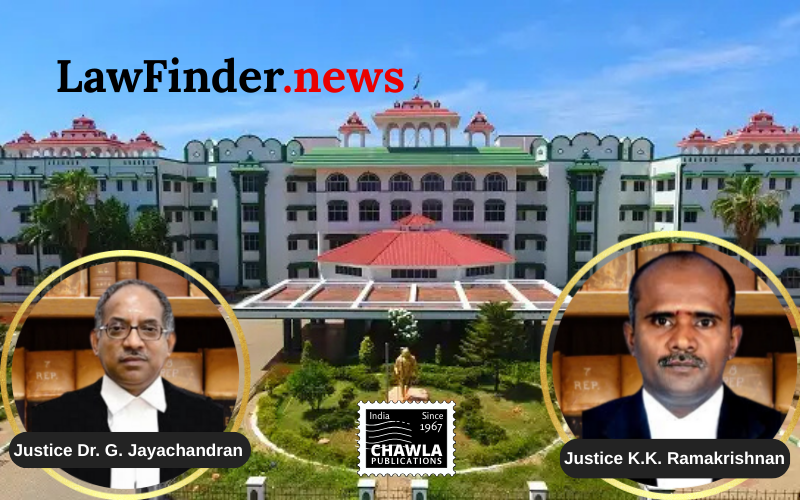
Court Asserts Judicial Orders Supersede Executive Directives, Ensures Protection for Religious Practices
In a significant ruling, the Madras High Court, through its Division Bench at the Madurai Bench, has reinforced the supremacy of judicial orders over executive actions concerning the right to religious worship. The Court directed the lighting of the Karthigai Deepam at the historic Deepa Thoon on Thirupparankundram Hill, emphasizing that the right of worship enshrined in Articles 25 and 26 of the Indian Constitution cannot be undermined by state authorities.
The case arose from a writ petition filed by Mr. Rama Ravikumar, who sought compliance with a previous court order mandating the lighting of the Karthigai Deepam at the designated location. Despite clear judicial directions, state authorities, including the District Collector and the Commissioner of Police, failed to implement the order, leading to contempt proceedings.
In the judgment, the High Court reaffirmed that judicial orders issued under Article 226 of the Constitution take precedence over executive orders, such as those issued under the Bharatiya Nagarik Suraksha Sanhita (BNSS), 2023. The Court criticized the state authorities for their deliberate disobedience and underscored that fundamental rights could not be compromised by executive actions.
During the hearing, the Court noted the failure of the temple authorities to light the Deepam as per the court's directive, which necessitated judicial intervention. The Court authorized the petitioners to perform the ceremony and ordered protection from the Central Industrial Security Force (CISF) due to the local authorities' inability to enforce compliance.
The judgment also addressed the balance of convenience, highlighting that the lighting of the Deepam would not infringe upon the rights of any other religious community. The Court observed that the opposition to the lighting ceremony appeared to stem from vested interests rather than genuine concerns.
Ultimately, the High Court dismissed the appeals filed by the state authorities, labeling them as attempts to circumvent contempt action. The Court's decision underscores the judiciary's role in upholding constitutional rights and ensuring that executive authorities adhere to judicial mandates.
Bottom Line:
Right of worship guaranteed under Articles 25 and 26 of the Constitution of India includes the right to perform religious ceremonies, such as lighting Karthigai Deepam at designated places, which cannot be disregarded by State authorities. Judicial orders under Article 226 of the Constitution prevail over executive orders issued under Bharatiya Nagarik Suraksha Sanhita (BNSS), 2023.
Statutory provision(s): Articles 25, 26, 129, 215 of the Constitution of India, Section 163 of Bharatiya Nagarik Suraksha Sanhita, 2023