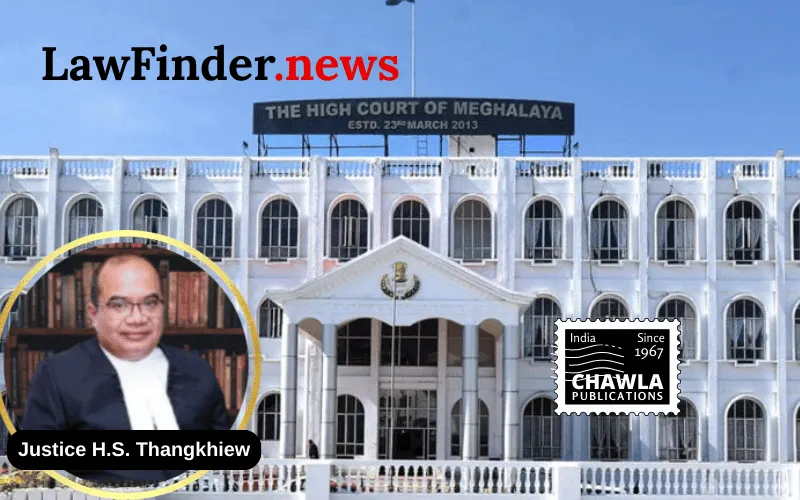
Court rules that the notification was invalid due to non-compliance with mandatory rule-making procedures and lack of Governor's approval.
In a significant judgment, the Meghalaya High Court has declared invalid a notification issued by the Executive Committee of the Garo Hills Autonomous District Council (GHADC) that mandated candidates for council elections to submit a Scheduled Tribe Certificate. The court held that the notification, dated February 17, 2026, failed to adhere to the prescribed rule-making process outlined under the Assam and Meghalaya Autonomous Districts (Constitution of District Councils) Rules, 1951, and lacked the essential approval of the Governor.
Justice H.S. Thangkhiew, presiding over the case of Enamul Hoque v. State of Meghalaya, underscored that the Executive Committee overstepped its authority by attempting to unilaterally impose such a requirement. The court emphasized that any modification of election qualifications must follow the procedure stipulated in Rule 72, which includes the drafting of rules by the Executive Committee, consideration by the District Council, and final approval by the Governor.
The case was brought forward by petitioner Shri Enamul Hoque, represented by Senior Advocate Mr. K. Paul, who argued that the notification violated the rights of non-tribal voters and candidates, as protected under the existing rules. The counsel highlighted that Rule 8 and Rule 128 of the 1951 Rules, which determine qualifications for membership and electors, have historically allowed non-tribals to vote and contest elections. The impugned notification, lacking legislative backing and procedural compliance, was thus deemed incompetent and unjustified.
Respondents, represented by Advocate Mr. S. Dey, contended that the notification aimed to protect the interests of indigenous tribal populations amidst changing demographics. However, the court found that the Executive Committee's actions did not conform to the legal framework requiring any such changes to be approved by the Governor after due process.
The court's decision reaffirmed the importance of adhering to constitutional provisions and statutory rules, maintaining the historical inclusivity of the electoral process in the Garo Hills Autonomous District Council. The judgment ensures the continuation of non-tribal participation in council elections, preserving the established electoral rights under the Sixth Schedule of the Indian Constitution.
Bottom Line:
Notification issued by Executive Committee of Garo Hills Autonomous District Council requiring Scheduled Tribe Certificate for contesting elections was held invalid as it did not comply with Rule-making process under Assam and Meghalaya Autonomous Districts (Constitution of District Councils) Rules, 1951, including approval of Governor.
Statutory provision(s): Assam and Meghalaya Autonomous Districts (Constitution of District Councils) Rules, 1951 Rules 8, 29, 30, 72, 128; Sixth Schedule to the Constitution of India Paragraphs 2(6), 2(7).
Enamul Hoque v. State of Meghalaya, (Meghalaya) : Law Finder Doc id # 2864196